Overview
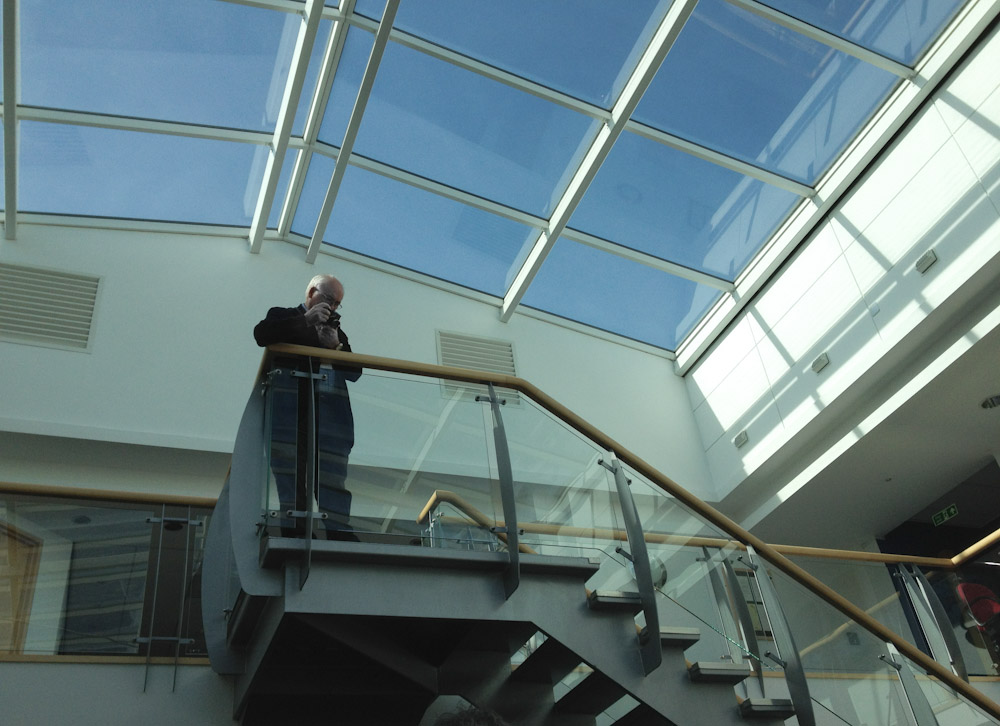
You can always rely on John to have an interesting perspective on technology.
Quentin Stafford-Fraser's blog
One should always have something sensational to read on the net...
Cambridge college dinners vary greatly, but one of the joys is their occasional unpredictability.
Tonight, for example, I sat next to the Costa Rican ambassador. She was delightful company, and we discussed our favourite scuba-diving spots...
A TED speaker's worst nightmare. Mac users will enjoy this...
Here it is on the TED site (also works for non-Flash users).
Pick your route to heaven…
🙂
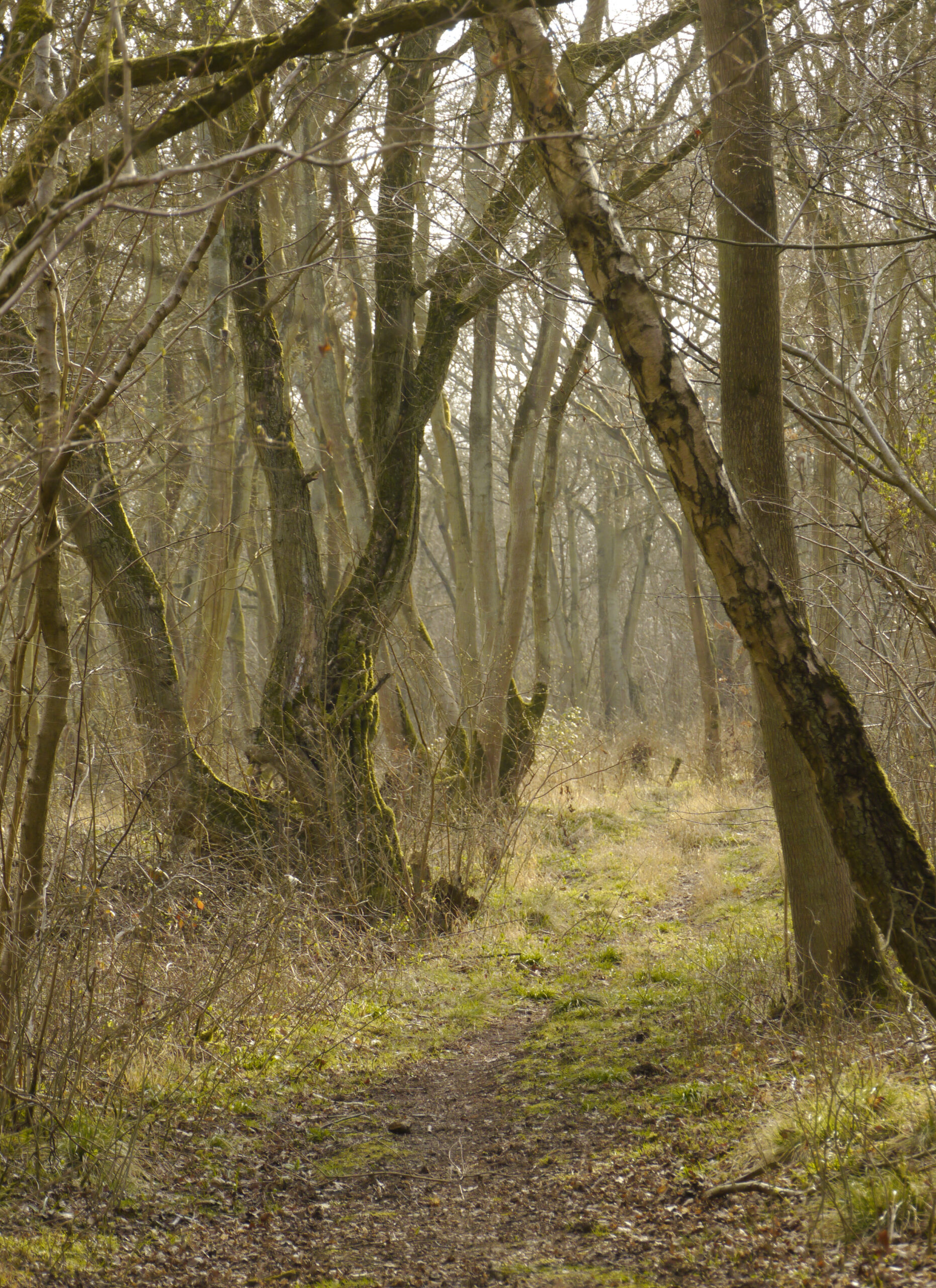
I came across this magical spot in a quiet wood this afternoon.
I half expected to catch a glimpse of a centaur in the clearing ahead…
One of the things those clever chaps at the BBC R&D are considering is the transmission of extra metadata alongside the programmes, whether on broadcast channels or over the net. This gave me an idea...
We watch TV in a room where I can, from my perch on the sofa, reach the dimmer switch on the wall. This is handy because I don't think it's ideal to watch TV in complete darkness, but I do often find that we start with the lighting at a certain level, and then, when we get to the gloomy, sinister scenes, I turn down the ceiling lights to make the low-contrast images more visible and reduce any reflections.
But as we move into an automated-home-internet-of-things type of world, where my dimmer may be accessible via zigbee, Z-wave or similar, perhaps the TV should be able to control the lighting? Screenplays generally specify whether a scene is 'interior, daytime' or 'exterior, night', for example, so including that in the transmission should be straightforward, and could possibly be automated. Maybe I as a viewer would feel more involved in the action if my lighting conditions matched those of the scene?
The next stage, of course, would be having the central heating automatically turn off when watching a documentary about Shackleton. Perhaps that's a step too far...
For a more serious immersive experience, I liked the idea the Beeb guys came up with a couple o years ago for 'surround video'.
I've always been fascinated by the work my friend Peter Robinson and his team have been doing at the University's Computer Lab, in trying to make computers both understand, and express, emotions.
But I hadn't seen this very nice little video they made just over a year ago.
The Encyclopedia Brittanica announced this week that, after 244 years, and like the OED not long ago, it was discontinuing its print-based editions. Tim Carmody has a very nicely-written piece on Wired, entitled "Wikipedia Didn't Kill Brittanica. Windows Did."
Extract:
Print will survive. Books will survive even longer. It's print as a marker of prestige that's dying. Historian Yoni Appelbaum notes that from the beginning, Britannica's cultural project as a print artifact was as much about the appearance of knowledge as knowledge itself. Britannica ""sold $250 worth of books for $1500 to middle class parents buying an edge for their kids,"" Appelbaum told me, citing Shane Greenstein and Michelle Devereux's study ""The Crisis at Encyclopædia Britannica."" In short, Britannica was the 18th/19th century equivalent of a shelf full of SAT prep guides. Or later, a family computer. ""I suspect almost no one ever opened their Britannicas,"" says Appelbaum. ""Britannica's own market research showed that the typical encyclopedia owner opened his or her volumes less than once a year,"" say Greenstein and Devereux. ""It's not that Encarta made knowledge cheaper,"" adds Appelbaum, ""it's that technology supplanted its role as a purchasable 'edge' for over-anxious parents. They bought junior a new PC instead of a Britannica.""The article's not long, and it's worth reading the whole thing. In the meantime, I love the fact that I can now carry both the Shorter OED and the Encyclopedia Britannica in my pocket...
In 1994, Knight Ridder's Information Design Lab produced a video which was their vision of the future of newspapers: The Tablet Newspaper. Have a look at around 2:20, and see if it looks at all familiar!
(I guess my nearest equivalent in gadget prediction is shown here.)
 Tucked away on a backup disk yesterday, I discovered a few thousand of my emails from the 1990s. And in the folder from late Feb 1992, I found something I thought was lost forever. Bob Metcalfe was visiting Cambridge, on sabbatical to the University Computer Lab, just as we were setting up the Trojan Room Coffee Pot camera. He wrote about it in his column in Communications Week, a publication which, sadly, closed down not long afterwards (roughly at the time when the camera was connected to the web and became quite famous). This original article was therefore, unknowingly, the first published reference to what was to become the world's first webcam.
But I didn't have a copy, and nor did Bob - the old Mac floppy on which he saved it would have been hard to read now even if he could have found it - and if anyone kept an archive of CommWeek articles, I haven't found it on the web. (Few people in 1992 would have heard of the World Wide Web, even those reading this kind of technical article.) But, as it went to press, Bob sent me a copy by email, and, sure enough, just over 20 years later, there it was, easily readable by my Apple Mail program.
There's probably some useful lesson there about the longevity of different data formats... Anyway, while it may have little interest to anyone not closely involved with networking technologies at the time, I'm still very glad that, with Bob's kind permission, I can now make the article available here. And I must take more care of my email archives in future...