Quote of the day
"Never criticise a man until you have walked a mile in his shoes.-- Anon
Then you can criticise him all you like, because he'll be a mile away and you have his shoes."
Quentin Stafford-Fraser's blog
One should always have something sensational to read on the net...
"Never criticise a man until you have walked a mile in his shoes.-- Anon
Then you can criticise him all you like, because he'll be a mile away and you have his shoes."
Quote of the day:
"A good programmer is someone who always looks both ways before crossing a one-way street."
-- Doug Linder
It was only after marrying a lawyer that I realised something which had never before occurred to me: practising law can be very similar to programming computers.
In both cases, you are trying to create a framework in which something can be achieved, while thinking of all the edge cases: all the ways it could go wrong; all the ways humans or other systems might be unpredictable, malicious or foolish, and catering for those situations as well as the ones you would normally expect to happen.
A good lawyer, like a good programmer, is someone who can expect the unexpected, and prepare for it. A really good one can also make their plan both brief and readable.
And to any other software professionals who occasionally have to read tedious legal documents, I recommend thinking of them (and their creators) in this way, and you'll probably find them rather more interesting!
I do like collecting quotations. Here are some of the references to them on this blog, and I also have a collection of favourites here.
But one thing you quickly discover, if you dig a little deeper, is that a large proportion of the most popular favourites cannot be traced reliably to the people to whom they are commonly attributed.
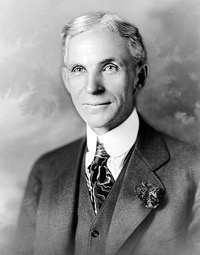
And here's the latest example I've found... If you've done anything related to innovation or product design, you've probably heard Henry Ford's famous comment:
"If I had asked my customers what they wanted, they would have said a faster horse!"
This is pretty well-known, but, once again, there seems to be very little evidence that he ever actually said it. There's a nice examination of the story on the Quote Investigator site.
If you're like me, for some reason, you find this slightly disappointing. But it's hard to work out quite why. Is it because, if we agree with a sentiment, and we then find that Henry Ford agrees with it too, it somehow validates our opinion? "You know, Henry Ford agreed with me on this..."
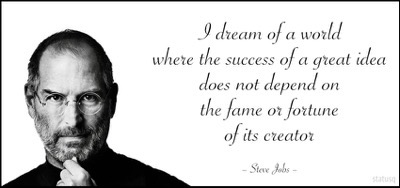
Anyway, I've written about this before, and you can find further discussion of this idea by clicking on the image below.
"Nobody wants 'backup'. Everybody wants 'restore'."
-- Heard on the Self-Hosted show, one of my favourite tech podcasts.
From Phil Giammattei's Mastodon feed...
Lord, grant me the acumen to automate the tasks that do not require my personal attention,
the strength to avoid automating the tasks that do,
and the wisdom to know the difference.
(Thanks to Rupert Curwen for reposting.)
From our "this may help you win a bet in the pub" collection...
If you know the quiz show 'QI', you might imagine Stephen Fry asking "With whom will the lion lie down?", and Alan Davies sheepishly responding "The lamb?"... before the claxons start, indicating a wrong answer.
Because if you look at Isaiah chapter 11, where the concept originates, you find rather different domestic arrangements:
"The wolf also shall dwell with the lamb, and the leopard shall lie down with the kid; and the calf and the young lion and the fatling together; and a little child shall lead them."
So unless they were all getting cozy around the same campfire, I'm afraid lions and lambs aren't prophesied to lie down together any time soon. As is so often the case, someone came up with a snappier version later on, and that's what stuck with us.
Now, is anyone else now thinking about that scene in Ghostbusters?
"A work of art", so the saying goes, "is never finished, merely abandoned."
This assertion rings true in many artistic spheres, to the extent that I've seen variations attributed to people as diverse as Leonardo da Vinci and W.H.Auden.
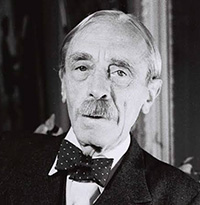 The site 'Quote Investigator' suggests that it actually originated in a 1933 essay by the poet Paul Valéry:
Aux yeux de ces amateurs d'inquiétude et de perfection, un ouvrage n'est jamais achevé, – mot qui pour eux n'a aucun sens, – mais abandonné ...
and they offer this approximate translation:
In the eyes of those who anxiously seek perfection, a work is never truly completed—a word that for them has no sense—but abandoned ...
My knowledge of French idiom falls short of telling me how significant Valéry's use of the word 'amateur' is, though. Is he saying that it's the professionals who really know when a work is complete?
~
Anyway, the same original core assertion is sometime used when speaking of software: that it's never finished, only abandoned.
It's rare that any programmer deems his code to be complete and bug-free, which is why Donald Knuth got such attention and respect when he offered cheques to anyone finding bugs in his TeX typesetting system (released initially in the late 70s, and still widely-used today). The value of the cheques was not large... they started at $2.56, which is 2^8 cents, but the value would double each year as long as errors were still found. That takes some confidence!
He was building on the model he'd employed earlier for his books, most notably his epic work, The Art of Computer Programming. Any errors found would be corrected in the next edition. It's a very good way to get diligent proofreaders.
Being Donald Knuth does give you some advantages when employing such a scheme, though, which others might want to consider before trying it themselves: first, there are likely to be very few errors to begin with. And second, actually receiving one of these cheques became a badge of honour, to the extent that many recipients framed them and put them on the wall, rather than actually cashing them!
For the rest of us, though, there's that old distinction between hardware and software:
Hardware eventually fails. Software eventually works.
~
I was thinking of all this after coming across a short but pleasing article by Jose Gilgado: The Beauty of Finished Software. He gives the example of WordStar 4, which, for younger readers, was released in the early 80s. It came before WordPerfect, which came before Microsoft Word. Older readers like me can still remember some of the keystrokes. Anyway, the author George R.R. Martin, who apparently wrote the books on which Game of Thrones is based, still uses it.
Excerpt from the article:
Why would someone use such an old piece of software to write over 5,000 pages? I love how he puts it:
"It does everything I want a word processing program to do and it doesn't do anything else. I don't want any help. I hate some of these modern systems where you type up a lowercase letter and it becomes a capital. I don't want a capital, if I'd wanted a capital, I would have typed the capital."
-- George R.R. Martin
This program embodies the concept of finished software — a software you can use forever with no unneeded changes.
Finished software is software that's not expected to change, and that's a feature! You can rely on it to do some real work.
Once you get used to the software, once the software works for you, you don't need to learn anything new; the interface will exactly be the same, and all your files will stay relevant. No migrations, no new payments, no new changes.
I'm not sure that WordStar was ever 'finished' , in the sense that version 4 was followed by several later versions, but these were the days when you bought software in a box that you put on a shelf after installing it from the included floppies. You didn't expect it to receive any further updates over-the-air. It had to be good enough to fulfill its purpose at the time of release, and do so for a considerable period.
Publishing an update was an expensive process back then, and we often think that the ease which we can do so now is a sign of progress. I wonder...
I had heard this before, but came across it again today and liked it anew. It's from Paul Batalden, a professor at Dartmouth Medical School in New Hampshire:
"Every system is perfectly designed to get the results it gets."
It's worth taking a moment to ponder that, for whatever kind of 'system' you may encounter in daily life! The corollary, I guess, is that you can only change the overall results by changing something in the system that produced them.
Now, I know from long experience that as soon as you refer to a quotation, it turns out not actually to be from the person to whom it's normally attributed. There are lots of examples of this in the quotes I've posted here, and more in the collection on my personal site. If Albert Einstein, for example, had been busy saying all the insightful things he is supposed to have said, he wouldn't have had time to develop Special Relativity into the more all-encompassing General Relativity.
But in this case, there is a nice article by Paul Batalden explaining the origins of the quote. It came, via a chain of references, from Arthur Jones, an employee of Proctor & Gamble, who originally said:
"All organisations are perfectly designed to get the results they get!"
For many people, an organisation is the type of system where this is most poignant, but it applies to other things as well.
Batalden took the concept and broadened it from the special case of an organisation to the more widely-applicable one of a 'system' and so it became more useful as an idea... much like General Relativity!
Merry Christmas, everyone! (Or Merry Boxing Day, for those of you who receive my posts by email the following day!)
I was browsing the forum of the Dinghy Cruising Association yesterday, and came across a nice line from a Steve Husband, who said he had been told by his dad that
Mother is the necessity of invention.
That probably means something different to everybody, so make of it what you will!
"A satisfactory hobby must be in large degree useless, inefficient, laborious, or irrelevant... a defiance of the contemporary... an assertion of those permanent values which the momentary eddies of social evolution have contravened or overlooked."
-- Aldo Leopold