Category: politics

A little younger and a bit more wise?

There's an old saying that if you're not a communist at the age of 20, you haven't got a heart. And that if you're still a communist at the age of 30, you haven't got a brain.

I was pondering this when I read about the proposals in the UK to lower the voting age to 16. In general, thinking back to my youth, I'm in favour of raising the age requirements for most things, even though it might shift the popular vote in a direction I wouldn't encourage! Student politics, while an entertaining way for the young to let off steam and learn about public speaking, are hardly the basis for running a civilised democracy. No, I thought; most people shouldn't be allowed to vote until after they have a degree certificate (or an equivalent number of years of real-world experience).

And then I remembered there are also proposals to block social media for under-16s. And that gave me pause for thought.

Because maybe 16 year-olds will soon be the only people capable of sane independent decision-making! So perhaps lowering the voting age wouldn't be so bad after all, as long as it didn't come into force until about six years after the social media ban...

Shakespeare on ICE: The strangers' case

Sir Ian McKellen was on the Stephen Colbert show a couple of nights ago, and gave an entertaining interview, but the final section has taken social media by storm, where he recites a speech from the Elizabethan play "Sir Thomas More".

The full interview is below (or available here if your browser or email reader doesn't display it), but the key bit starts at 20:00.

(The clip is also here for posterity.)

Speaking truth to power

There has been a great deal written about Trump's long-winded and childish ramblings at Davos.  Even if you ignore the stuff about Greenland (which he mistakenly called 'Iceland' four times), here are a couple of paragraphs selected almost at random.

"Because of my landslide election victory, the United States avoided the catastrophic energy collapse which befell every European nation that pursued the Green New Scam – perhaps the greatest hoax in history. The Green New Scam: windmills all over the place, destroy your land. Destroy your land. Every time that goes around, you lose $1,000. You're supposed to make money with energy, not lose money."

and

"China makes almost all of the windmills, and yet, I haven't been able to find any wind farms in China. Did you ever think of that? That's a good way of looking at it. They're smart. China's very smart. They make them. They sell them for a fortune. They sell them to the stupid people that buy them, but they don't use them themselves.

They put up a couple of big wind farms. But they don't use them. They just put them up to show people what they could look like."

Just FYI, China has the largest wind-power generation of any country, more than twice that of the US, and gets rather more of its power from wind than the US does from coal.

If, on the other hand, you'd like to read the speech of somebody who has a brain, take a look at what Mark Carney, the Prime Minister of Canada, said at the same event.

If I lived in the USA, those two links on their own would be enough to make me emigrate northwards.

Living without America... continued

There was a lovely story back in 2022 about how Russian troops stole $5M-worth of tractors, combine harvesters and other agricultural machinery from a John Deere dealership in Ukraine. They took them over the border, presumably thinking it was an excellent day's work. But... farm vehicles are not as primitive as they used to be: the theft was tracked remotely using their built-in GPS, and when the thieves tried to start up these machines, after transporting them 700 miles, they found they couldn't. The manufacturer had disabled them remotely using an in-built kill-switch.

Though there were many appealing aspects to this tale of thwarted Russian criminal invaders, others, including Cory Doctorow, cautioned at the time that any such systems are generally very bad news.  "It’s important not to get swept up in the industry’s self-serving cheerleading about these kill-switches working in ways we like, because of all the ways they can go wrong."  And he cites the example of similar kill-switches in Medtronic's medical equipment.

I was thinking about this as I got into my Tesla after writing last week's article about European dependence on American IT systems.  I've written before about the embarrassment now of owning an (otherwise excellent) Tesla, so it's also sobering to think that, of all the kill-switches in all the vehicles in all the world, I had to have Elon Musk's finger on mine!

As an aside, when I told my wife last week that China's BYD had overtaken Tesla as the world's largest EV manufacturer, and that their cars were rather good, she said, "Oh great!  Now we'll have to choose between a fascist car and a communist car!"  So, I thought, perhaps our next one will one of those fine European vehicles from Volvo or Polestar.  Or the cute newelectric  Renault 5.  And then I remembered that their software comes from... Google.  And into my mind flashed that picture of Sundar Pichai standing between Bezos and Musk at Trump's inauguration...

I had some interesting responses to my post.  Rory Cellan-Jones wrote about it in his newsletter.  Extract:

"It would not take more than a few hours for us to realise how totally dependent we are - at home and at work - on American technology. Tens of thousands of my photos and videos would be trapped in the iCloud, my email account, provided by Google, would become inaccessible, even this Substack would sputter to a halt - Google’s AI Overview (something else I wouldn’t be able to access) tells me most of Substack’s servers are located in the United States.

This set me thinking about the digital revolution finally happening in UK healthcare and how reliant on American technology it is...."

Yes, the NHS would be one of the first casualties.  I'm less concerned about Cory's kill-switches in individual medical devices than I am about every other aspect of its IT infrastructure.

Juho Vepsäläinen pointed me at this European Parliament Draft Report indicating that they have been starting to take ‘technological sovereignty’ seriously. It notes that "92% of the West’s data are stored in the USA [and] 69% of Europe’s cloud market share is held by US companies".

These discussions have been going on for a little while; a search for 'EuroStack', for example, will turn up various events at the European parliament in the last few months with titles like "Building Europe’s Tech Resilience".

But, as John Naughton points out after linking to Rory's post and mine in in his Observer column:

"...as we acknowledge how comprehensively we’ve embedded US tech into our critical infrastructure, it’s clear that we should have been paying more attention to the implications of where we were headed."

There is, however, evidence that the big cloud infrastructure providers are very aware of these concerns and the effect it might have on their revenues.  Just today, Amazon announced the 'AWS European Sovereign Cloud', which you can read about at https://www.aws.eu (Yes, note the URL).

"An independent cloud for Europe

The AWS European Sovereign Cloud is a new, independent cloud for Europe entirely located within the European Union (EU), designed to help customers meet their evolving sovereignty requirements.

Built in Europe for Europe, it is the only fully-featured, independently operated sovereign cloud backed by strong technical controls, sovereign assurances, and legal protections."

And if you read the rest of the website, it sounds like a pretty thorough attempt to provide isolation.   "Excellent!", I thought, "I can see whether my clients would be interested in taking advantage of this."

I read on:

"The first AWS Region of the AWS European Sovereign Cloud is located in the State of Brandenburg, Germany. We have also announced plans to extend the AWS European Sovereign Cloud footprint from Germany across the EU to support stringent isolation, in-country data residency, and low latency requirements. This will start with new AWS Local Zones located in Belgium, the Netherlands, and Portugal."

Sounds good!  I wonder if Microsoft and Google will follow suit?

And it was then that I remembered.  

The UK isn't in the EU any more.  And, in fact, our GDPR regulations say that we shouldn't really store our data there, any more than we should store it in the US.  This probably won't buy us anything.  Everyone else may get independence from America, but what about us?

Sigh.  Don't you just love Brexit?  You know, that thing that people voted for because it would give us back our sovereignty?

Living without America

About 25 years ago, friends and I ran a website called Living Without Microsoft. It was a news, reviews and advice hub for anyone considering the revolutionary idea that you could actually use a computer – maybe even run a company, school or government department – without being dependent on Windows and Office; without incurring the significant costs that a monopoly could impose; and without the viruses and other security risks associated with Microsoft software.

It wasn't, we pointed out, that we had anything against Microsoft per se (though many people did back then, and with good reason). We just believed that the situation was unhealthy and wanted to educate people about more wholesome alternatives. It has to be said that it was quite a challenge at the time: perfectly possible for individuals, but much harder for companies that needed to run accounting software or do desktop publishing.

Fortunately things are much easier now, and many people can run their lives quite happily with little or no reference to Microsoft, if they want to. This is partly due to the success of the web and the fact that Open Source software has essentially won the race to power the world's servers. It's partly because Microsoft failed, despite desperate attempts, to control the world's web browsers that gave access to them. And it's significantly due to the success of Apple and Google when it comes to the hardware and software that we actually sit in front of and carry in our pockets daily.

But there may be a bigger problem looming on the horizon.

You see, Microsoft, Apple, Google and Meta are all American companies. And (as the recent minor AWS outages demonstrated), a very great number of other organisations depend on infrastructure which is either physically in the USA, or is owned by companies which are.

And as Donald Trump seems ever more keen to become the new Putin, this may be a problem, and it may affect you. Sooner than you think.

There was a scare earlier this year when Trump regime imposed sanctions against the International Criminal Court because he didn't like them criticising Israel, and shortly afterwards the ICC prosecutor who was his main target lost access to his Microsoft services. Later, Microsoft denied that these were in any way connected, but further information has been scarce, and the thing that really worried people was not whether it actually happened, but the fact that it now seems totally plausible that it might. In October, the ICC announced that it was ditching Microsoft Office in favour of an Open Source alternative.  Mmm.

This is a pattern that is starting to become more common, as the idea of 'digital sovereignty' becomes ever more desirable. The German State of Schleswig-Holstein moving 30,000 PCs to Linux and LibreOffice is one recent example. A ministry in Denmark has been doing the same thing. The Austrian Ministry of Economy started the adoption of Nextcloud, hosted on its own hardware, when its licence for Teams and Sharepoint expired. And just last month the main Belgian DNS registrar announced that it was leaving AWS, and put out a request for proposals from European alternative platforms. "The geopolitical reality is forcing us to think more carefully about our infrastructure", they said. "Ten years ago, we made the decision to switch to AWS, which has certainly benefited our services. But the world has changed, and those benefits no longer outweigh the risk we run if the US suddenly imposes restrictions or tariffs on cloud usage."

So let's imagine that Trump decides to invade Greenland. I like to think that the whole of Europe would be up in arms and would start significant economic reprisals against the US, but even if our leaders continue to be as weak as they have been in response to some of Trump's other actions, we can still perhaps imagine one of the following taking place:

  • Your country's leaders do have the guts to be outspoken about it, and Trump decides to switch off your country's access to AWS or Azure or Google Cloud or iCloud, or double your IT costs by imposing 100% tariffs, or even just impose bottlenecks to slow down your internet access to US-based services.
  • Your own government announces that you must promptly move your data out of any data centres controlled by US companies.
  • Your employees, as a matter of principle, object to your company's dependence on and financing of a US company, and go on strike until you sort it out.
  • Your biggest clients decide that they will only purchase products or services from companies who are not at risk from repercussions of 'the tense geopolitical climate'.

... and I'm sure you can think of other variations.  You may not find them all plausible.  But it only takes one.

A few days ago, the village in which I live, and much of the surrounding area, had a power outage. I looked out of our upstairs windows, and all was dark. It only lasted a couple of hours, but we sat there feeling a little bit smug, I must confess, because a couple of years ago we had installed sufficient solar panels and batteries at home to run the house for about 24 hours, even in winter, without needing any power from the grid. Our neighbours were lighting candles while we boiled our electric kettles and settled down to stream movies on TV, having been unaware for quite some time that there was an outage going on around us.  More importantly, at this time of year, our heating system, though gas-based, still had an electricity supply to run the valves, controls and thermostats.   Sometimes it's your less-obvious dependencies that can cause you the biggest problems in case of failure.

As I read about the threats to NATO and the talk of America possibly invading part of Europe, I became rather conscious of how much of my digital life is dependent on US-controlled infrastructure. Where do I host my blog? My email may be stored in this country, but what about the DNS service that tells people where to send it? I have Zoom and Teams calls with clients next week – what would happen if they became unavailable? I host a significant amount of my technical infrastructure myself, in preference to depending on cloud services, but I realised that even I have a long way yet to go.

So here's my question for you to ponder today: If your access to American-controlled cloud services was suddenly interrupted, seriously curtailed, or became prohibitively slow or expensive next week, would your school or university still be able to function?  Would parents and students even be able to find out whether it was open? And will it be you, or your business competitors, who are left sitting in the cold and dark by candlelight?

Update: some further thoughts a few days later.
Misrepresentation

Generally I'm a fan of the Liberal Democrat party here in the UK. Have voted for them on numerous occasions, in fact, though I can't remember whether I did last time. But I do wish they wouldn't resort to such nefarious tactics.

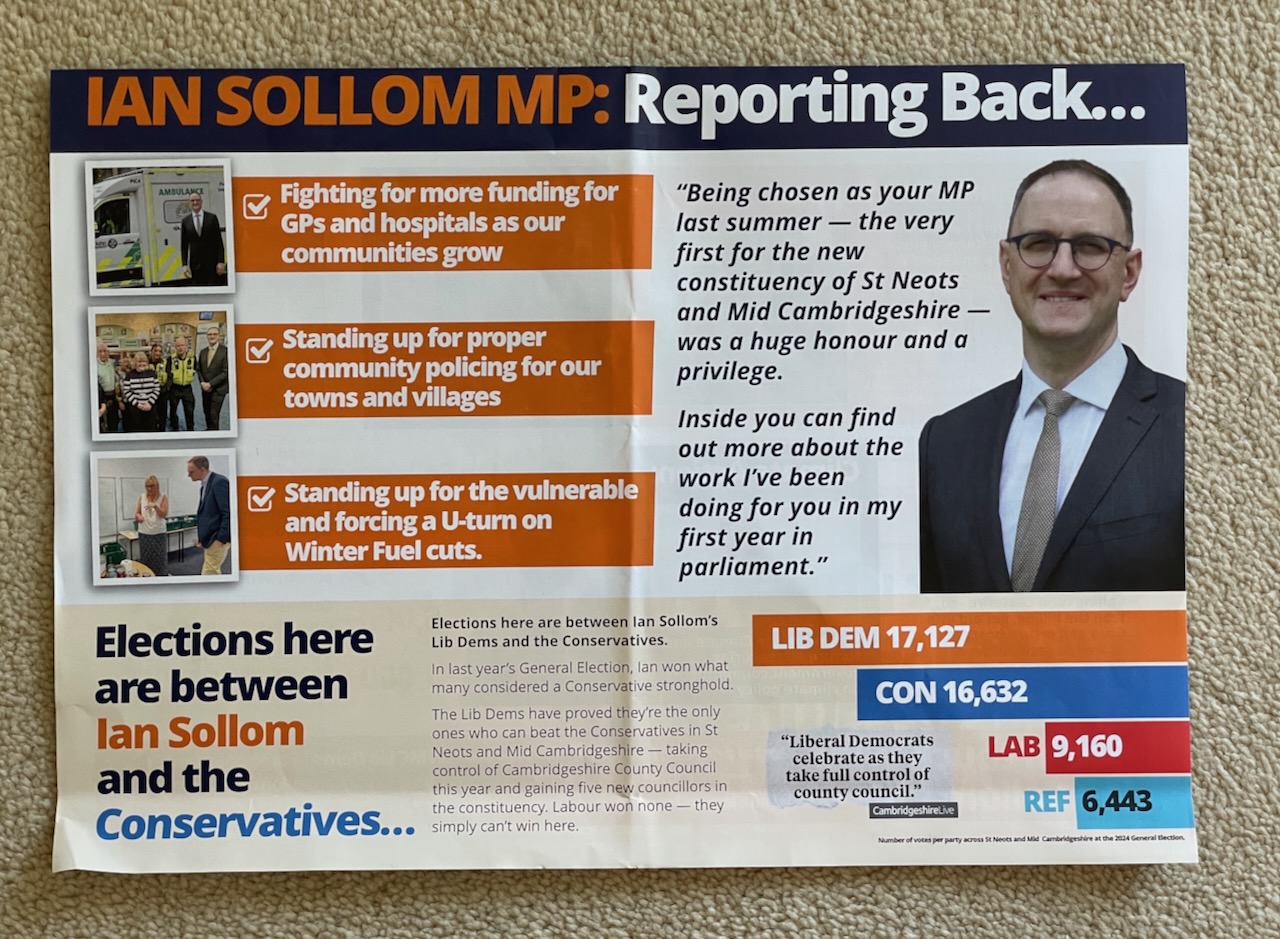
Here's a cheery letter that just came through the door from our MP, Ian Sollom:

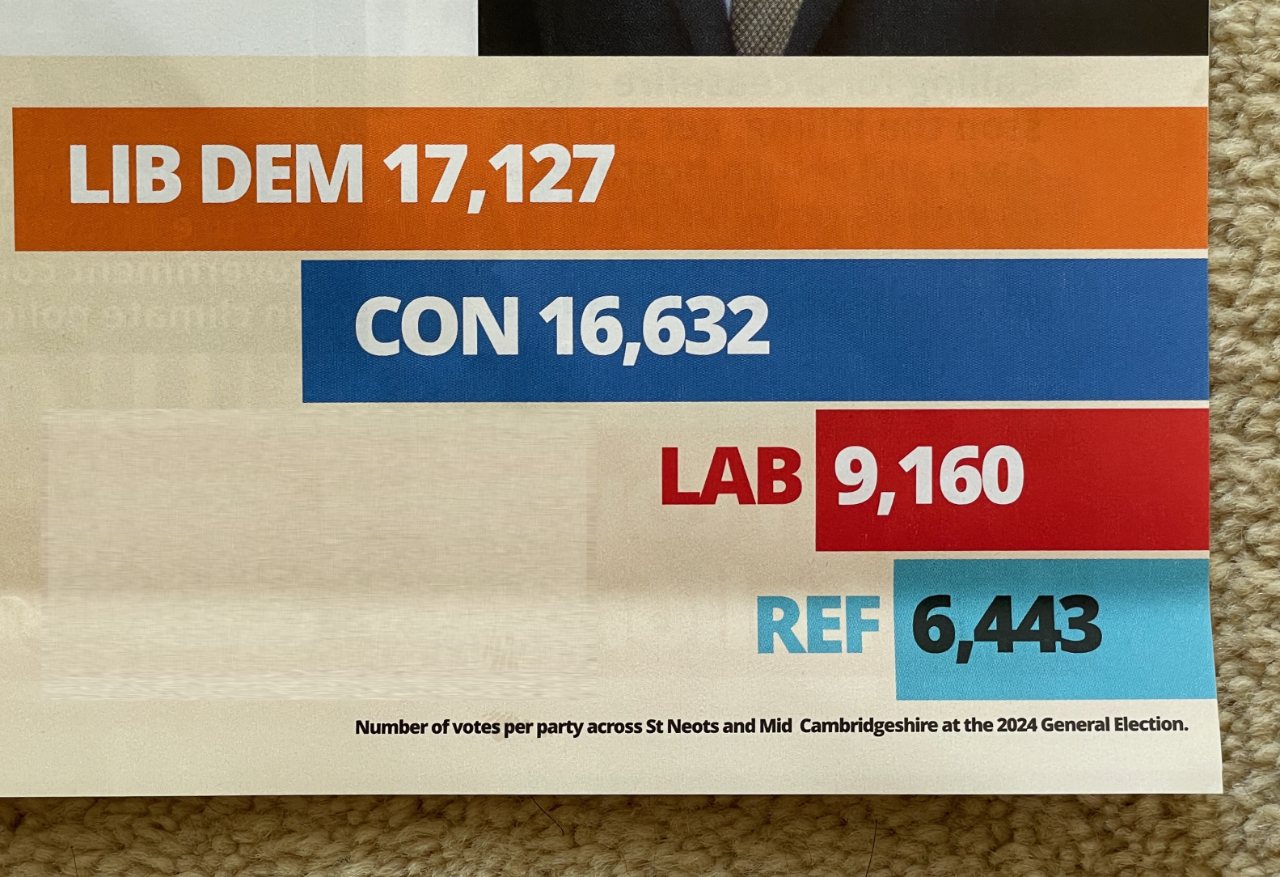
Let's take a look at that bar chart in the bottom right corner:

Basically, it (and the tone of this and other newsletters) is clear: our only close competition in this area was the Conservatives, and Ian gave them a damn good thrashing! Hurrah!

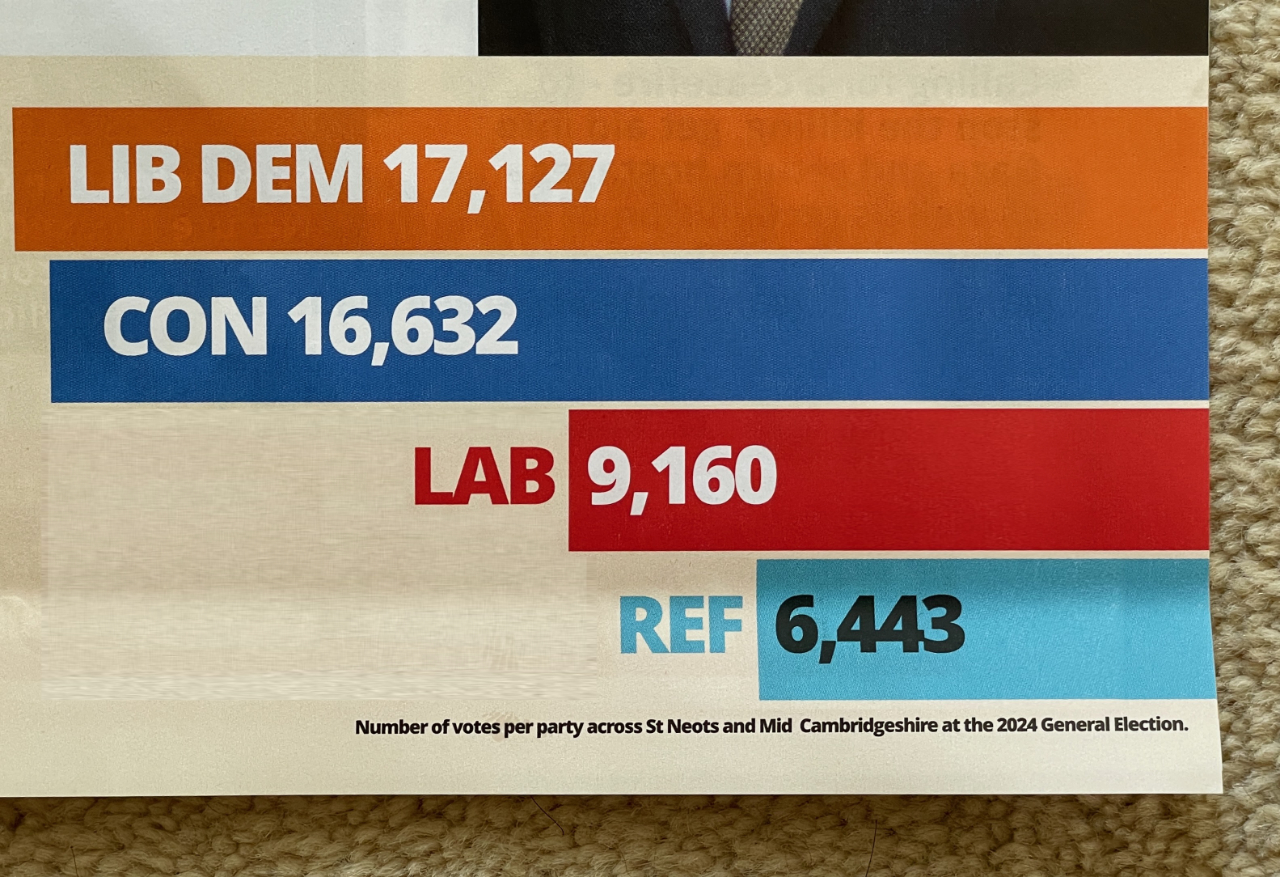
But look more closely at the actual numbers, and you'll see that the Conservative vote was actually over 97% of the Lib Dem vote! Is that what this chart says to you? And Labour got more than 50% of the Lib Dem number. Don't get me wrong, I'm still glad they won, but this chart is deliberately misleading - somebody created this, and made a choice to falsify the dimensions.

With the help of a bit of photoshopping, I can show you what the chart should look like to represent the facts accurately:

That looks less like a 'damn good thrashing' and more like 'by the skin of our teeth'!

It wouldn't surprise me to hear that Mr Sollom isn't the only one guilty of similar mathematical fraud. I wonder if the Advertising Standards Authority take any interest in political campaigns...

Hydrographic humour

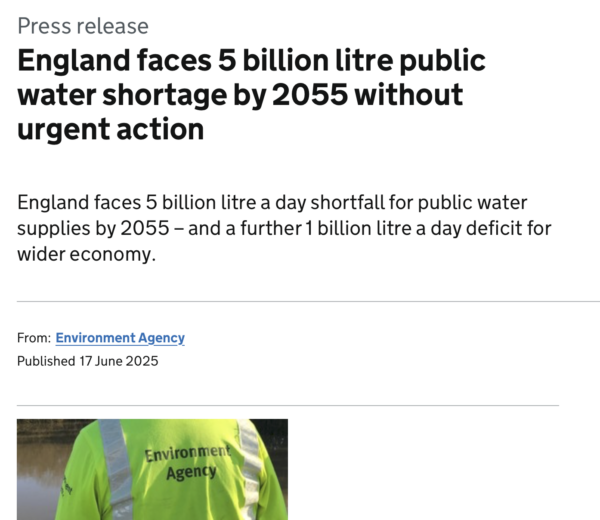
It's good to have something to make you laugh at the start of your day. Today, I was particularly taken by this article on a UK government website:

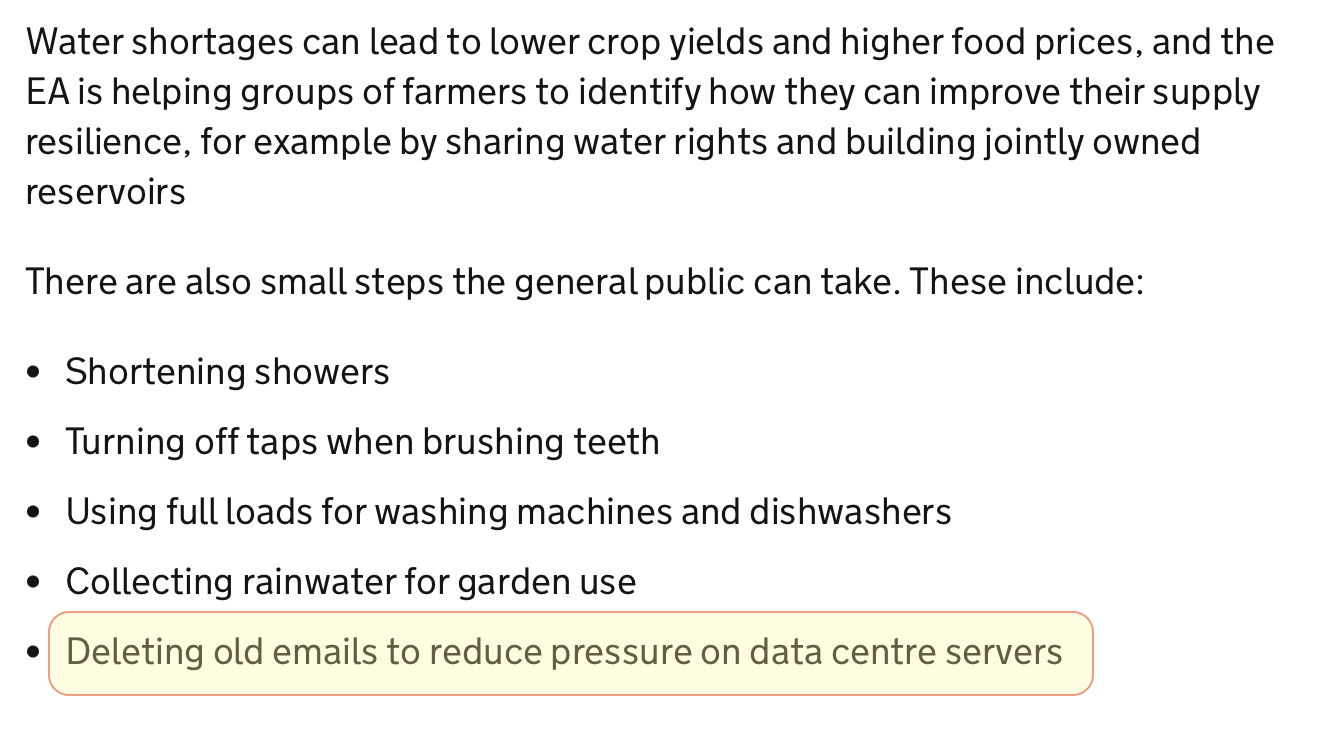
It wasn't the headline that made me laugh, of course - that's pretty serious. No, what caught my attention (thanks to mhoye on Mastodon) was further down, where they offer the general public some advice on how the they can help mitigate the situation:

Fabulous! Yes, it's those emails from granny that are really emptying the reservoirs! Free up some hard disk space and the rivers will flow freely again! I particularly like the use of the word 'pressure'.

So I'm now left contemplating a set of possibilities, in increasingly worrying order:

  • This was put in as a joke, to test whether the editor actually read the article before publishing it, or...
  • The article was actually written using ChatGPT, or...
  • We actually have people this foolish working for our government agencies and publishing recommendations on their behalf.

Mmm....

Curiouser and curiouser

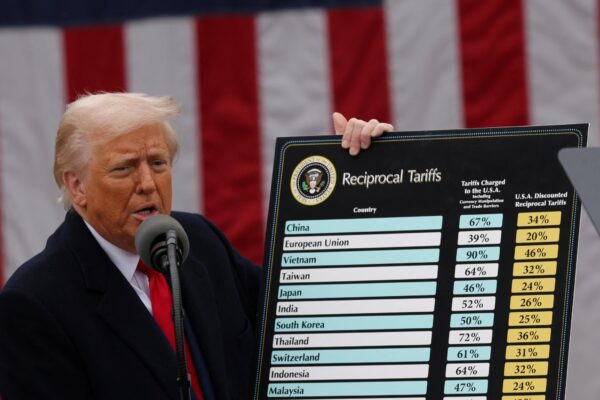
Amongst the more bizarre aspects of the Trump tariff announcements last night were the figures he came up with for the tariffs being charged by other countries.

Even people who are as unfamiliar with economics as I am wondered, "Where on earth did he get those from?" They didn't seem to bear any resemblance to reality. And while lies are part and parcel of most Trump announcements, the numbers had to come from somewhere, surely?

Well, it turns out that's because they're actually not to do with tariffs at all. These are not extra costs being imposed by other countries. They are simply a measure of the trade deficit that the USA has with those countries. Or, to put it another way, the degree to which US citizens want stuff from your country more than your citizens want stuff from the US... that's how much we're going to punish your country.

The FT has more details and an appropriate dose of incredulity. As they point out, suppose your country sells lots of bananas to the US... Well, bananas don't grow in the US, so Americans can't buy them locally. But we're still going to impose tariffs...

"The numbers [for tariffs by country] have been calculated by the Council of Economic Advisers ... based on the concept that the trade deficit that we have with any given country is the sum of all trade practices, the sum of all cheating,"" a White House official said, calling it ""the most fair thing in the world.""

Per Capita

My friend Rupert posted today on Mastodon:

'It would really help if every time a news article mentioned an amount of money that a country was spending on something, they also gave the cost per person. We are very bad at the scale of large numbers, and a little "50p per person" or "£158 per person" would help us all to grasp the significance of things.

It's common practice when reporting on taxes and borrowing, but rare for spending. But these are two sides of the same thing, surely?'

I thoroughly agree.

For me, by far the most interesting figure about, say, the NHS annual budget, is that it's roughly £2600 per person. Or that each person in our house is paying something like £1000 for HS2.

And when we decide we want to double the NHS budget, or cut HS2, or whatever, multiplying those by the number of people in the house suggests the kind of influence it might have on our household taxation.

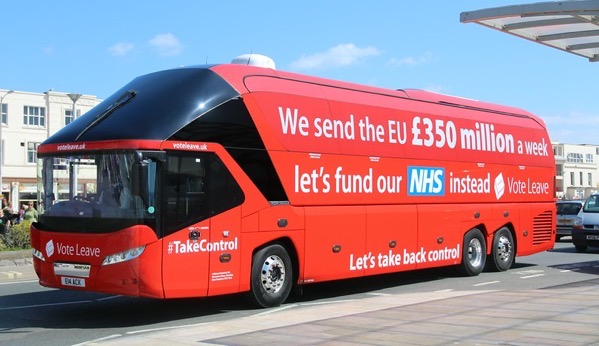
And of course, Boris's big Brexit Bus lie:

would have rather lost its impact if it had made the equivalent claim: "We each send the EU about 70p a day".

(Not forgetting, of course, that the real number was about half that.)

We're not in Lake Wobegon any more, Toto

For those struggling to understand the US election results, I can only offer the following statistical observations:

  • Roughly half of the world are of below-average intelligence.
  • Roughly half of the world are of above-average gullibility.
  • More than half of the world are on social media.

Sometimes these combine in unfortunate ways.

For those not familiar with the Lake Wobegon stories... Each monologue would end with, "That's the news from Lake Wobegon, where all the women are strong, all the men are good-looking, and all the children are above average."