Category: Internet

Facing the book

OK, so despite telling a friend yesterday that I was trying to cut down on 'social networks', I've been persuaded that Facebook is now a socially acceptable forum even for people over 20. So here's my shiny new profile.

As with LinkedIn, though, I'm going to restrict my list of contacts to people I've actually met. Or at least spoken to on the phone...

Let's see how it goes.

Surfin' Safari

Mmm. That's interesting. Steve Jobs has just announced the imminent release of the Safari browser for Windows - there'll be a beta release later today.

That's very smart. iTunes is one of the most popular Windows apps. It'll be interesting to see how Safari does... And anything which ups the market share of minority browsers is a good thing in my book.

Update: Safari 3 Beta is now available, from http://www.apple.com/safari/. This was posted with it. The Mac version, of course! It does seem rather snappier, and has a few nice features - the ability to rearrange tabs and tear them off to form separate pages is cool, and very nicely implemented. One thing I've often wanted is to be able to move a tabbed page from one window to another, so that windows are groups of pages on a particular topic. Now it's easy....

netrenderer

Anyone who's done any quantity of web design knows that there are often two phases to the process. The first involves creating your design using nice, clean, standards-compliant HTML and CSS, and the second involves inserting tweaks and hacks to get around the bugs and quirks of Internet Explorer.

Most web designers tend not to use IE. This is not just because of its failings; it's often because other browsers offer designers facilities which make the development process easier; perhaps the best example is the excellent (and free) Firebug extension for Firefox.

In addition, most people of a creative or technical bent don't use Windows; they use platforms such as Mac or Linux where IE isn't available. But they do need to check what the sites will look like for people still using IE. So NetRenderer is a useful service - you type in a URL, pick your version of IE, and it promptly displays the image of your page under that browser.

MacFusion

Michael blogged recently about MacFUSE, which lets you mount SSH-accessible servers as file shares on your Mac. It's very handy.

And now it has a prettier front-end, in the form of MacFusion.

Panic Coda

Panic Inc have just released their new Mac application, Coda. This came to our attention initially because we're also developing something called CODA, albeit in a very different space. Pity, but there are lots of other codas out there (codi? codae?), so I guess there's room for us all!

Anyway, I had a bit of a play with Panic's app last night and it's very cute. Panic are the guys who make Transmit, widely acknowledged as the best FTP app for the Mac, or, it is generally agreed, for any platform. So new products are watched with interest.

CODA is an editor for web developers. It's not a Dreamweaver or anything like that, but for those (like me) who want to write HTML and CSS directly, it's a very nice package. When you open a 'site' you get tabs for source editing, CSS editing, preview, and an SSH terminal, all with file access provided by their FTP/SFTP/Webdav engine.

Panic Coda

This sounds like the dreaded Swiss-Army-knife approach and could be a complex mess, but the creators have drawn it all together in a seamless and exceedingly elegant package, that I find rather tempting...

Here, and here are a couple of reviews if you want more details and some screenshots.

YouTube pulls ABC videos... unnecessarily

Life for IP lawyers is never dull. Or always dull, I guess...

Perth (Australia) - A teenager managed to outsmart YouTube by sending DMCA notice that forced the video sharing giant to take down hundreds of videos. The 15-year-old Perth boy pretended to be with the Australian Broadcasting Corporation and requested that clips from the show "The Chaser's War on Everything" be removed. YouTube complied and many of those videos are still offline. YouTube's lawyers tracked down the boy who has since confessed and apologized for his misdeeds. The interesting part is that the broadcasting company didn't have any problem with the YouTube clips and its executives actually encourage clips to be shared.
from tgdaily

The new debating medium

Once upon a time, those who wished to conduct vigorous debate would send letters to the Editor. Now, everything is much more sophisticated. Let me explain...

First, many thanks to CD Happel for pointing me at this great video of a juggling demonstration by Chris Bliss. It's impressive - watch and enjoy.

Update 2012 - Google Video has now gone: You can watch it here instead.

However, another juggling enthusiast, Jason Garfield, pointed out that technically, Chris's act is not so complicated. Simply posting this to a blog wouldn't have had much impact, though, so he made a video of himself juggling to the same music but with five balls instead of three. You can see it here. It became known (or was christened by him) as the 'Bliss Diss' video. Also very impressive, but in different ways.

This apparently caused some debate in the juggling community about which was really the most difficult routine and whether Chris's choreography was better than Jason's. Jason got so much email - often vitriolic - that he decided to post another video explaining his position. In it he shows Chris's video with multiple different background tracks, to show that it appears to be nicely choreographed with any of them.

Now, as someone who could barely juggle two balls to 'Baa baa black sheep', I am not qualified to make any assessment of the juggling technicalities. I suspect Jason is probably right, but his message has come over as rather negative so I, like many others, instinctively react against it after getting such a postitive vibe from Chris's video above.

What interested me, however, was his his use of the media. He stated that he wouldn't read any more of the aggressive email he was getting. If you want to send him a message, sit in front of a video camera and send him a clip explaining, or demonstrating, your position. We've all seen the 'flame wars' where people engage in heated arguments on forums or in email that would presumably never have become so vicious in a face-to-face encounter. I think Jason may have hit upon an excellent way of keeping things more civil. Have a look at his explanation.

It's also interesting that we've reached a point where it's reasonable to request anybody feeling strongly about a subject to make a video of themselves talking about it and broadcast it globally - something that would be unthinkable just a few years ago. Much of the population of the developed world now carry in their pockets the technology needed to do just that.

That's even more amazing than the juggling.

Twitter

Your Status-Q quote for the day comes from Norman Lewis's eTel talk:

The search for acknowledgement is the key to most online activity.
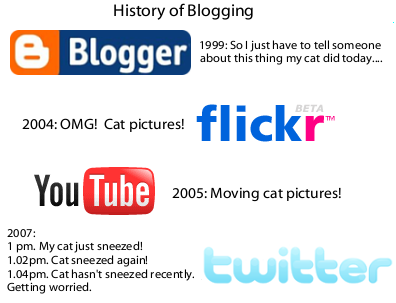
Yesterday I signed up for a Twitter account, to see what all the fuss was about. I was more interested in it as a social phenomenon than because I actually wanted to use it. Which probably indicates that I'm getting old. For those who don't know it, Twitter is all the rage amongst the youth of today. You can type out a few words saying what you're currently doing, and anyone interested in watching can keep up to date with your exciting life. Twitter is to instant messaging what blogging is to email; it's chiefly a broadcasting mechanism rather than a conversation. This is very convenient for the youth of today, who would otherwise need to send the same updates to their 15 simultaneous IM conversations. You can send Twitter updates using your mobile, via the web, using an IM client, or a dedicated application, and you can keep track of your friends in a variety of ways including via RSS. To clarify things, here's the 'History of blogging': History of blogging (Many thanks to Dave Briggs, who found this on Mashable.)

Call me

Quote of the day comes from Stephen Uhler of Sun, who, in his talk at eTel, said:

Cellphones have reduced peoples' expectation of the phone system to the point where VoIP is now viable.
He's quite right - it wasn't that long ago that you would have been very surprised, upset even, if a phone call were just to hang up unexpectedly... Now, as a friend and I once discussed, there's a problem. We need a new social convention. When the line drops, who should re-initiate the call? The person who made the call in the first place? The person with the cheapest outgoing charges? We decided that it was probably the person who was on the move, assuming at least one party was mobile. Because they're the ones who will know when they're back in a good coverage area. Of course, we also realised that in an ideal world the service provider, or the phone, would do this for you. "Press 1 to have the call reconnect automatically when possible..."

Europe's feeling foxy

The Firefox browser continues to gain popularity in Europe, with a market share of just over 23%, according to research done by a French firm and reported in The Inquirer.

We in the Royaume Uni are a little behind some of our neighbours at 15.8%, while Slovenia has adopted Firefox to a whole-hearted level of over 40%.