Category: Internet

When DOES it make sense to use AI?

I created my first neural network back in the late 90s, as part of my Ph.D, to do handwriting recognition on images of whiteboards. It wasn't a very good network; I had to write the whole thing from scratch as there weren't any suitable off-the-shelf libraries available, I didn't know much about them, and I didn't have nearly enough training data. I quickly abandoned it for a more hand-tailored system. But one of the early textbooks I was reading at the time had a quote, I think from John S Denker, which I've never forgotten: "Neural networks are the second-best way to do almost anything."

In other words, if you know how to do it properly, for example by evaluating rules, or by rigorous statistical analysis, don't try using a neural network. It will introduce inaccuracies, unpredictability, and make it very much harder either to prove that your system works, or to debug it when anything goes wrong.

The problem is that there are many situations in which we don't know how to do it 'properly', or where writing the necessary rules would take far too much time. And 'machine learning', the more generic term encompassing neural networks and similar trainable systems, has advanced amazingly since I was playing with it. For many tasks, we also now have masses of data available, thanks to the internet. (I was playing with my toy system at about the same time as I was experimenting with these brand new 'web browsers'.) So while it remains the case, as a Professor of Computer Science friend of mine likes to put it, that "Machine learning is statistics done badly", it can still be exceedingly useful. It would almost certainly be the right way for me to do my handwriting-recognition system now, for example, and over the last few decades we've discovered lots of other pattern-matching operations for which it is essential - analysing X-rays for evidence of tumours is just one example where it has saved countless lives.

But all of this is nothing new. So why the current excitement about 'AI'? After all, 'artificial intelligence', like 'expert system', is one of those phrases we heard a lot in the 70s and 80s but had largely abandoned in more recent decades, until it came back with a rush and is now the darling of every marketing department. Every project that involves any kind of machine learning (and many things that don't) will now be reported with 'AI' somewhere in the title of the article, even though it has nothing to do with ChatGPT, Claude, or Gemini.

And the reason is that, by appearing to have an understanding of natural language, generative LLMs have opened up the power of many of these systems to the non-technical general public, in the same way that the web browser in the 90s opened up the power of the Internet, which had also been in existence for decades beforehand, to ordinary users. (Many people ended up thinking the Web was the Internet, just as many people probably think ChatGPT has something to do with newspaper headlines about AIs diagnosing cancer.)

But it's not an analogy I'd like to push too far, because the technology of the World Wide Web did not invent new data, did not mislead people, did not presume to counsel them or tell them that it loved them. The similarity is that you needed to be something of an expert to make use of the Internet before the web, and you were therefore probably better able to judge what you might learn from it. If machine learning is statistics done badly, then 'AI' is machine learning made more unreliable, sounding much more plausible, and sold to the more gullible. Take any charlatan and give him skills in rhetoric, and you make him much more dangerous.

Regular readers will know that I am quite a cynic when it comes to most current uses of AI, and I consider myself fortunate that I was able to spot lots of its failings very early on. A few recent examples from ChatGPT, Gemini and other systems, some of which have been reported here, include:

  • Telling me that one eighth of 360 degrees was 11.25 degrees. (Don't trust it to do your financial planning!)
  • Telling a teenage friend that the distance from Cambridge to Oxford was 180 miles; she swallowed that whole and repeated it to me confidently. (It's actually more like 80 miles.)
  • Telling me that my blog was written by... well, several other people over the years, some of whom were flattering possibilities! (But there are several thousand pages here which all say "Quentin Stafford-Fraser's Blog" at the top.)
  • Suggesting a Greek ferry to a friend, as a good way to get to Santorini in time for our flight. (It didn't actually run on the days suggested, and we would have missed our flight if we had relied on it.)
And of course, the press has regular reports of more serious problems: So, some time ago, I announced Quentin's AI Maxim, which states that
"You should never ask an AI anything to which you don't already know the answer".
And for those who say, "But the AI systems have got a lot better recently!", I would agree. Some of my examples are from a few months ago, and a few months is a long time in AI. But I would also point out that, on Friday, when I asked the latest version of Claude to suggest some interesting places for a long weekend in our campervan, within about 2 hours' drive from Cambridge, one of its suggestions was Durham, which would probably take you twice that if you didn't stop on the way. I pointed this out, and it agreed.
"You're right to question that...I shouldn't have included it. Apologies for the error..."
Now, if I had been asking a human for suggestions, they might have said, "Mmm. What about Durham? How far is that from here?" But the biggest danger with these systems is that they announce facts just as confidently when they are wrong as when they are right, and they will do that whether you are asking about a cake recipe or about treatment for bowel cancer. Fortunately, I already knew the answer when it came to the suitability of Durham for a quick weekend jaunt! But here's the thing... Thirty-four years ago, I was very enthusiastic about two new technologies I had recently discovered. One was the Python programming language. The other was the World Wide Web. In both cases, more experienced research colleagues were dismissive. "It's not a proper compiled language." "We've seen several hypertext systems before, and none of them has really caught on." They were probably about the age that I am now. So, I don't want to be 'that guy' when it comes to AI. (Though I'm glad I *was* when it came to blockchains, cryptocurrencies and NFTs!) All of which brings to mind that wonderful quote from Douglas Adams:
"There's a set of rules that anything that was in the world when you were born is normal and natural. Anything invented between when you were 15 and 35 is new and revolutionary and exciting, and you'll probably get a career in it. Anything invented after you're 35 is against the natural order of things."
So in the last few weeks I have been doing some more extensive experiments with AI systems, mostly using the paid-for version of Claude, and the results have often been very impressive. They can be great brainstorming tools; I have to admit that some of the suggestions as to where we might go in our campervan were good ones... I'm just glad I didn't select the Durham option. They can be great search engines... just don't believe what they tell you without going to the source, or you too may have to call the coastguard. But perhaps I should modify the 2026 version of Quentin's AI Maxim to say something like:
You should never ask an AI anything where you don't have the ability, and the discipline, to check the answer.
And one of the areas where checking the answer can sometimes be an easier and more rigorous process is in the writing of software. I've been doing that a fair bit recently, and will write about that shortly. In the meantime, I leave you with this delightful YouTube short from Steve Mould. His long-form videos are always interesting - he has 3.5M followers for a good reason - and though I tend to avoid 'shorts' in general, this is worth a minute and half of your time.

Living without America

About 25 years ago, friends and I ran a website called Living Without Microsoft. It was a news, reviews and advice hub for anyone considering the revolutionary idea that you could actually use a computer – maybe even run a company, school or government department – without being dependent on Windows and Office; without incurring the significant costs that a monopoly could impose; and without the viruses and other security risks associated with Microsoft software.

It wasn't, we pointed out, that we had anything against Microsoft per se (though many people did back then, and with good reason). We just believed that the situation was unhealthy and wanted to educate people about more wholesome alternatives. It has to be said that it was quite a challenge at the time: perfectly possible for individuals, but much harder for companies that needed to run accounting software or do desktop publishing.

Fortunately things are much easier now, and many people can run their lives quite happily with little or no reference to Microsoft, if they want to. This is partly due to the success of the web and the fact that Open Source software has essentially won the race to power the world's servers. It's partly because Microsoft failed, despite desperate attempts, to control the world's web browsers that gave access to them. And it's significantly due to the success of Apple and Google when it comes to the hardware and software that we actually sit in front of and carry in our pockets daily.

But there may be a bigger problem looming on the horizon.

You see, Microsoft, Apple, Google and Meta are all American companies. And (as the recent minor AWS outages demonstrated), a very great number of other organisations depend on infrastructure which is either physically in the USA, or is owned by companies which are.

And as Donald Trump seems ever more keen to become the new Putin, this may be a problem, and it may affect you. Sooner than you think.

There was a scare earlier this year when Trump regime imposed sanctions against the International Criminal Court because he didn't like them criticising Israel, and shortly afterwards the ICC prosecutor who was his main target lost access to his Microsoft services. Later, Microsoft denied that these were in any way connected, but further information has been scarce, and the thing that really worried people was not whether it actually happened, but the fact that it now seems totally plausible that it might. In October, the ICC announced that it was ditching Microsoft Office in favour of an Open Source alternative.  Mmm.

This is a pattern that is starting to become more common, as the idea of 'digital sovereignty' becomes ever more desirable. The German State of Schleswig-Holstein moving 30,000 PCs to Linux and LibreOffice is one recent example. A ministry in Denmark has been doing the same thing. The Austrian Ministry of Economy started the adoption of Nextcloud, hosted on its own hardware, when its licence for Teams and Sharepoint expired. And just last month the main Belgian DNS registrar announced that it was leaving AWS, and put out a request for proposals from European alternative platforms. "The geopolitical reality is forcing us to think more carefully about our infrastructure", they said. "Ten years ago, we made the decision to switch to AWS, which has certainly benefited our services. But the world has changed, and those benefits no longer outweigh the risk we run if the US suddenly imposes restrictions or tariffs on cloud usage."

So let's imagine that Trump decides to invade Greenland. I like to think that the whole of Europe would be up in arms and would start significant economic reprisals against the US, but even if our leaders continue to be as weak as they have been in response to some of Trump's other actions, we can still perhaps imagine one of the following taking place:

  • Your country's leaders do have the guts to be outspoken about it, and Trump decides to switch off your country's access to AWS or Azure or Google Cloud or iCloud, or double your IT costs by imposing 100% tariffs, or even just impose bottlenecks to slow down your internet access to US-based services.
  • Your own government announces that you must promptly move your data out of any data centres controlled by US companies.
  • Your employees, as a matter of principle, object to your company's dependence on and financing of a US company, and go on strike until you sort it out.
  • Your biggest clients decide that they will only purchase products or services from companies who are not at risk from repercussions of 'the tense geopolitical climate'.

... and I'm sure you can think of other variations.  You may not find them all plausible.  But it only takes one.

A few days ago, the village in which I live, and much of the surrounding area, had a power outage. I looked out of our upstairs windows, and all was dark. It only lasted a couple of hours, but we sat there feeling a little bit smug, I must confess, because a couple of years ago we had installed sufficient solar panels and batteries at home to run the house for about 24 hours, even in winter, without needing any power from the grid. Our neighbours were lighting candles while we boiled our electric kettles and settled down to stream movies on TV, having been unaware for quite some time that there was an outage going on around us.  More importantly, at this time of year, our heating system, though gas-based, still had an electricity supply to run the valves, controls and thermostats.   Sometimes it's your less-obvious dependencies that can cause you the biggest problems in case of failure.

As I read about the threats to NATO and the talk of America possibly invading part of Europe, I became rather conscious of how much of my digital life is dependent on US-controlled infrastructure. Where do I host my blog? My email may be stored in this country, but what about the DNS service that tells people where to send it? I have Zoom and Teams calls with clients next week – what would happen if they became unavailable? I host a significant amount of my technical infrastructure myself, in preference to depending on cloud services, but I realised that even I have a long way yet to go.

So here's my question for you to ponder today: If your access to American-controlled cloud services was suddenly interrupted, seriously curtailed, or became prohibitively slow or expensive next week, would your school or university still be able to function?  Would parents and students even be able to find out whether it was open? And will it be you, or your business competitors, who are left sitting in the cold and dark by candlelight?

Update: some further thoughts a few days later.

Making our home network even more secure?

We awoke this morning to find that our internet connection was offline.  I did a range of diagnostic tests and came to the conclusion that the problem was with the fibre network outside our house, rather than with anything on the inside.  

We get our broadband from EE. This is a re-badging of BT's service, and it's cheaper than BT if you happen to have any EE SIMs in any of your devices, because then they can call it a package and give you a multi-service discount.  Anyway, I sent them a text, they called me back very promptly, we went through some more diagnostics and they agreed that an engineer needed to come out, and could do so tomorrow.

It was only later that I thought I might walk around the outside of the house and just see if there was any obvious damage to the fibre.  And I discovered that some local security consultant, probably with a bushy tail, sharp teeth and a fondness for nuts, had decided to secure our network by making it properly air-gapped from the outside world.

Mmm.  I can't imagine that two inches of optical cable made for a very tasty meal...  though perhaps he read Dennis Burkitt and is a great believer in the importance of dietary fibre.

A timely lesson

My thanks to Terence Eden, who recently reposted on Mastodon the fact that Google are shutting down their 'goo.gl' URL-shortener in a month's time.

URL shorteners are those services that take long URLs and turn them into shorter ones by maintaining a database mapping the latter to the former. Tinyurl.com was perhaps the first; bit.ly is another one. They can be handy as a temporary way to send someone a more manageable link, but you shouldn't rely on them for anything important or long-term.

Even if they don't come from a company that has Google's reputation for killing things off, it's worth remembering that any URL that you don't control yourself is dependent on at least one other person or organisation. The more proxies and the more third parties invoved in getting to the content, the less likely it is that somebody in the future will be able to use the link successfully.

My blog is over 24 years old now, and it's a salutory thought that the average lifespan of companies even on the S&P 500 is only about 15 years. Even if a big company doesn't cancel its shortening service, it may be cancelled itself before too long! I've just replaced the two 'goo.gl' links in my past posts and, though I'm glad to see that tinyurl.com is still going strong and outliving the S&P average, I've replaced most of those too.

However, it's not always that easy to replace them. As Terence points out, a vast number of academics have been unfortunate or unwise enough to use 'goo.gl' links in hundreds of thousand of citations in PDF papers... and they'll all stop working by the end of August. The one ray of light here is that the ever-wonderful Internet Archive Wayback Machine seems to remember where those links pointed to when it last scanned them. So if you've used a goo.gl link anywhere important, you might want to check whether it has been captured.

In general, though, remember that the only URLs you can be confident have a long-term future are the ones you control and preserve yourself!

Everything Broken Everywhere?

Readers in the UK will be familiar with the 'EE' mobile network operator, and those with a long memory may recall that its original name was 'Everything Everywhere'. Well, that's just what they have been failing to provide today.

I spent a happy few hours today trying to work out why my mother's phone wasn't able to make or receive calls. It's a difficult thing to diagnose remotely, so, after the first hour, I drove an hour down the road to her house to carry on the investigation.

Eventually, after checking all the possible mobile-service-related settings on the iPhone, restarting, rebooting, turning airplane mode on and off -- you know the routine -- I started experimenting with swapping SIMs with my Vodafone one, and found that her EE SIM could only call landlines and not other mobiles. Eventually I came to the conclusion that it had to be something related to her actual mobile account or connection.

Had she run out of credit or minutes or something? Why, in that case, couldn't she receive calls either? I logged into her EE account -- no issues reported there. Installed their app -- nothing reported there. They had a web page where you could check for any known issues in your area -- all showing a happy, green status. I'm embarrassed to admit that I still have a Twitter account, so I looked at '@EE': nothing posted there either... for a year or more.

Because the key thing you really want to know at this stage is, "Is it only me? Is anybody else seeing this? Could it actually be an issue not related to my account or my equipment?"

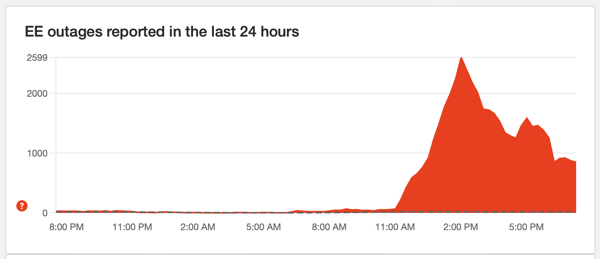
And then I searched Twitter for what other people were saying about '@EE'. And that's when I discovered that no, we most certainly were not alone! There were huge numbers of people suffering from the same issues. And gradually, other websites like TechRadar started to report on what was happening, mostly initiated by the reports on DownDetector.

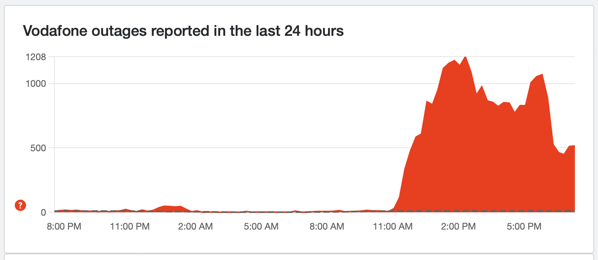
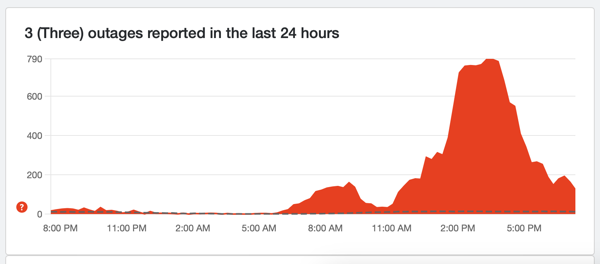
It turns out that it's not just EE: Vodafone and Three have been having problems today too:

So it's a pretty nationwide problem.

But try finding any reference to it on the websites of any of these companies! I couldn't. In fact, it's pretty hard to find a proper support page at all. I have both Vodafone and EE SIMs myself, yet has anybody notified me that there might be problems? Not a squeak.

All they need is a banner at the top of their website saying, "Sorry, some customers are experiencing problems with their mobile service at present. We're working on it!" That would have saved me a couple of hours of driving and a couple of hours of troubleshooting today. But when companies get to a certain size, they stop caring about communicating with their users, and the marketing departments have more clout than the customer support departments. Cory Doctorow has a word for this.

Of course, it may also be that companies over a certain size have so much bureaucracy in place relating to their online presence that they can't actually make quick changes to their website to respond to issues in a timely fashion!

So I'm going to start paying more attention to sites like DownDetector. It would be a source of distress to me if I had to depend on Twitter(X) for anything these days.

And another thing occurred to me. This was, I think, only an issue with routing traditional phone calls between networks. (That's not a trivial problem; I can remember, for example, when you could only send SMS texts to people who were on the same network as you were. I'm much less concerned that the networks had technical challenges than I am that they did such an appalling job with customer communication when it happened.) But here's the thing: I don't think you would have been affected if you were making your calls with FaceTime. Or Signal. Or if you'd made that Faustian bargain and used WhatsApp. (And, possibly, even if you'd enabled Wifi calling and used your normal number routed over the internet.) People under 35 probably barely noticed.

No, this particular outage affected those making traditional phone calls in the traditional way. And I wonder for how much longer that'll be an issue?

More coffee-pot nostalgia

For those who read this blog and haven't yet exhausted their enthusiasm for Trojan Room Coffee Pot nostalgia, Peter Leigh has just produced what is perhaps the best video about it yet, on his 'Nostalgia Nerd' YouTube channel.

(Direct Youtube link, for those reading by email)

You'll have to get busy skipping YouTube ads, but it's very nicely done.

Misplaced trust

This might be a little technical for some readers, but don't worry, it's not actually the technical detail that's important...

On my home server, I run about half a dozen services that I need to access via a web browser, so they're all behind a Caddy reverse proxy which connects me to the right one, depending on the name I use in my browser: 'homeassistant', 'unifi', 'searxng', 'octoprint' etc. (All of these names are aliases for the same machine.)

One of these services is Nextcloud, which has user accounts, and I was thinking it would be handy if I could use those accounts to authorise access to the other services. Can I allow someone to use my web search frontend only if they have an account on my Nextcloud server, for example?

I thought I'd try out an AI system to see if it could speed up this process, because they're often good at this kind of thing - Google Gemini, in this case. And, to my delight, it gave me pages of detailed instructions.

It knew that Nextcloud supports the OpenID Connect system, told me how to set it up, and then how to use the oidc directive in the Caddy configuration file to connect the two, so that Caddy could ask Nextcloud whether the user should be allowed in. It gave me nice examples of oidc actually in use, and the parameters you'd need to configure when using it to talk to the Nextcloud instance.

"Great!", I thought, and grabbed a coffee, went upstairs to my machine, and started typing code to try it out. And it was then that I discovered...

Caddy doesn't actually have an oidc directive.

Making 'social' social again?

Back in about 1996, I was attending a conference in San Francisco. As we walked into the Moscone centre to register, we were all given not only the usual branded bag and bits of paper, but something much more exciting: a box containing what was to become my first true pocket-sized mobile device, the recently-released Palm Pilot.

Palmpilot professional cradle.

I don't know whose idea it was to give these to everybody attending the conference, or how the finances worked, but it was a brilliant move. Not only was it an exciting surprise, but we immediately had an application for it: the conference proceedings were available on it, and you could slip it into your back pocket; something you certainly couldn't do with the paper equivalent. And there was something more important, which I'll come back to in a moment.

But for those less ancient than me, I should perhaps explain that what was brilliant about the Palm Pilot was the things it didn't try to do. It had been preceeded a couple of years before by the Apple Newton, for example, which was a lovely device, but just tried to do too much and was thus expensive, large and heavy on power. The Palm guys realised that what people really wanted was just a cache, in their pocket, of the stuff they had on their PC. (Laptops were heavy, and expensive, with a short battery life, and you had to wait for Windows to boot up before you could check someone's address. You might have one in your hotel room, but you probably wouldn't carry it around.)

With the Palm devices, though, you would create and manage most of the content on your computer, which had a proper keyboard and screen. When you got back to your desk, you'd plug the device into its cradle, press the sync button, and any changes would zip to and fro, after which you could unplug it and put it back in your pocket. If you had migrated away from paper diaries and address books to keeping data on your PC, this allowed you to have that information back in your pocket again.

But you did have to plug it in to its cradle periodically, where it could talk to the PC using an RS-232 serial port. This was before 802.11 (the standard which, several years later, would become known as 'WiFi') and the Palm Pilot had no other networking. Well, almost none.

And that was, I think, really important.

You see, the lack of WiFi meant that it couldn't distract you all the time with incoming messages. You could read email on it, but only the email that had been received on your PC when you last plugged the two together. So you would actually listen to what was being said at the conference: something almost unheard of these days!

But the device did have one further trick up its sleeve: it had infrared capabilites. It could exchange information with other Palm Pilots (and later with some other devices), using the same kind of line-of-sight connection that TV remotes used. That meant that for me to get your address and you to get mine, we needed actually to have met and collaborated in the exchange. I could send you my contact details across a conference table or while having a drink at a bar, in much the same way I could give you a business card, but it was so much more convenient because there was no need to transcribe the information afterwards if you wanted it in digital form.

This did require both of us to have Palm Pilots, of course, so what better way to kick this off than to make sure that, at a few key tech conferences, almost everybody you bumped into, for several days, would have one in their pocket?

~

Back in the early days of LinkedIn, there was a similar culture of only linking to people you actually knew; in fact, not only knew, but endorsed. I joined the beta release back in early 2004, and to this day I normally only link to people I've at least actually met, though in more recent years I've extended that to include 'met on a video call' or 'had really quite a long phone call with'.

Nowadays, I do sometimes wonder why I'm still on LinkedIn, since it's the source of more spam in my inbox than anything else. I'm not really out hunting for jobs. I've always joked -- and it's almost true -- that I've never got any job I applied for and I've never applied for any job I got. And I'm not recruiting people either at present. LinkedIn is very much a work-related system, but having dropped in to the website just now for the first time in ages, I must confess that there was more interesting content on there than I expected, perhaps because it is linked to people I actually know in real life.

(Increasingly, social networks are things I visit in the same way I might visit parties; drop in for a while, see what the atmosphere is like, leave if it doesn't appeal, but maybe visit again a few weeks later. I've just deleted the Twitter app from all my devices because I realised I could still drop in there using the web if wanted, but I didn't need its content, or its notifications, delivered to my pocket.)

~

Anyway, I was thinking about all of this as I read Ev Williams' article, Making "Social" Social Again, in which he announces the launch of Mozi. This is meant to be a social network to help you with your actual social life (and not a 'social media' platform). It's about getting and maintaining up-to-date contact information for your friends, and knowing about their travels so you could meet up with them.

I don't know whether it'll succeed. There's always the problem of bootstrapping a network when you can't, say, give several hundred people a sexy new device that they'll all be carrying around in their pockets for a few days. But it would be good to have something that is primarily about contacts rather than content, and yet isn't primarily about work.

And he reminded me about Plaxo:

As I was making my birthday list, another, more practical, thing struck me: I had no go-to source for knowing who I knew. No online social network reflected my real-life relationships. The closest thing, by far, was the contacts app on my phone.

And, boy, was that a mess. I'm guessing, yours is too.

Why?

Twenty years ago, there was an internet company called Plaxo. There have been others like it, but Plaxo was the first big online address book. I remember thinking it was one of those simple but profound twists on an old product that was now possible because of the internet, i.e.: Why do I have to keep details up to date for hundreds of people in my address book? Now that we have the internet, you can update your address in my address book, and I only have to keep mine updated.

It was an obvious idea. And here we are, 20+ years later, with address books full of partial, duplicate, and outdated information.

Anyone encountering the same problem while writing Christmas cards?

The problem with Plaxo was that it required you to upload your address book to their servers, and I always felt uncomfortable with that. When someone gives you their details, their is an element of trust involved. They might not want you to broadcast their home address to the world, and they're kind of assuming you won't.

But nowadays, most people do this anyway, they just often don't know that they're doing it. It's one of the reasons that, for a long time, I didn't want to have anything to do with WhatsApp, Facebook and Instagram. But I abandoned my principles last year when I realised that all those friends I was trying to protect were already using those services and so all of their contact information was there anyway. And, because of them, so was mine. GDPR, eat your heart out!

Signal, in contrast, has a much better system which allows them to discover whether your contacts are on Signal without actually uploading your address book. In a world where we have these kind of techniques, and end-to-end encryption, and protocols for sending contact information, why is it that I can't give you the permission to update your entry in my address book without my address book being stored on someone else's servers?

I don't know if Mozi will enable that. If they do, then I'll believe we've made some progress from last millennium, when I could send you my current information with a couple of clicks and a beam of infrared.

Wisdom of the crowds, or lowest common denominator?

I liked this:

People have too inflated sense of what it means to "ask an AI" about something. The AI are language models trained basically by imitation on data from human labelers. Instead of the mysticism of "asking an AI", think of it more as "asking the average data labeler" on the internet.

...

But roughly speaking (and today), you're not asking some magical AI. You're asking a human data labeler. Whose average essence was lossily distilled into statistical token tumblers that are LLMs. This can still be super useful of course. Post triggered by someone suggesting we ask an AI how to run the government etc. TLDR you're not asking an AI, you're asking some mashup spirit of its average data labeler.

Andrej Karpathy

Thanks to Simon Willison for the link.

Surviving the search engine meltdown

Today, I got yet more evidence that the web is sinking in a world of AI-generated slime.

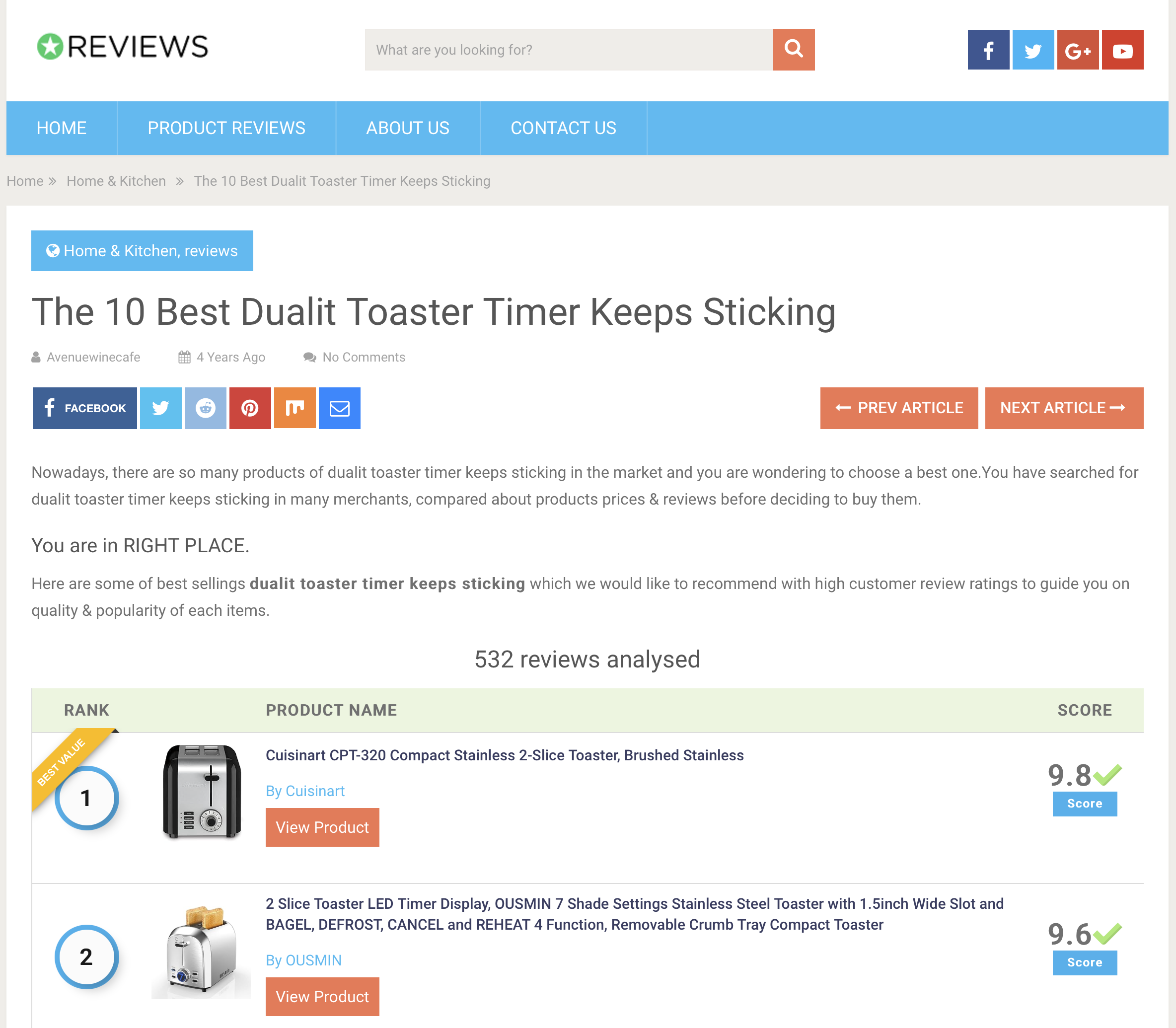
Our otherwise-fine Dualit toaster has, after many years, started to have occasional hiccups with its timer... I think the clockwork has become a little dodgy. So I did a quick search to see if others had the same experience, and I got this page back as one of the top hits:

I quote: "Nowadays, there are so many products of dualit toaster timer keeps sticking in the market and you are wondering to choose a best one."

There's a danger that we may soon move past the time of useful online search --- Peak Google, if you like -- and the alternative approach of trying to ask questions of an AI will only make things worse, since studies have already shown that training AIs on AI-generated content quickly leads to madness (for the AIs, that is, not the users, though that too would probably follow soon afterwards).

So making the most of online content in the future may depend, more than ever before, on being able to ensure that it comes from a trusted human source. Who's old enough to remember when the web was small enough that human-generated indexes were the best way to find things?

But this is also why, as John Naughton nicely reminds us in an Observer piece this weekend, the best human-generated and human-curated content out there is often available via your RSS reader, not your search engine. (I happen to like News Explorer, and have used it for a few years.)

RSS -- a system for telling you when your favourite sites, especially blogs, have been updated without you needing to go and look at each one every day -- has existed since long before Facebook and these other trendy things now called 'social networks' existed, and I suspect will still be around after they've gone. But if RSS doesn't appeal for some reason, much of the best content -- including, of course, John's blog and this one -- is also available via an even more time-tested channel. Your email inbox.