Inversion
US government now owns all your homes. Russian stock market booms. Let's hope nobody's waking up from 30-year coma.Charles Arthur (on Twitter)
Quentin Stafford-Fraser's blog
One should always have something sensational to read on the net...
US government now owns all your homes. Russian stock market booms. Let's hope nobody's waking up from 30-year coma.Charles Arthur (on Twitter)
Hap snapped this picture of Rose and me in Tonbridge Castle car park last weekend trying to find somewhere to stay for the night (using a combination of an OS map and a wifi connection to my phone).
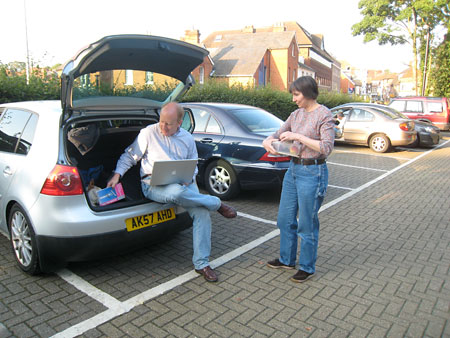
I was successful in finding places, but not ones with any spare rooms at such short notice. At least, not before my phone's battery ran out. It was tired after a long day of being my SatNav.
Incidentally, Quentin's theory of technological linguistics says that a technology is truly pervasive when you no longer capitalise it. How would you write 'satnav'?
 You know those coverage maps that mobile service providers create? The ones that tell you that, yes, there's blanket 3G coverage in your favourite holiday destination, but when you get there you discover mean 'slight 3G coverage for people sitting on top of their chimneys facing west under optimal stratospheric conditions'?
Well... it strikes me that, now phones have accessible GPS data, we shouldn't need to rely on these particular bits of marketing propaganda. Somebody could write a phone app which periodically captures details of the signal and the phone's location, and uploads them to a service which creates a map showing the true picture. Imagine you could look at your movements over a month or two and discover which operator would really provide you personally with the best service. If you were running the application, the system could even tell you that automatically! (Which would be a good way to get the data-gathering mechanism widely adopted).
Has anyone done this? I might write it up as a student project proposal...
...for a fuller and happier life.
Carpe Dessertumwhich, liberally translated, means "Seize the pudding"
Sorry - it's late - getting silly....It's fascinating to watch people discover new ways of using the iPhone/iTouch. The fun, I'm sure, is only just starting. It's the first widely-deployed device that has a multi-touch interface. It's the first mobile device with really good accelerometers in it. It's the first thing you can drop easily into your pocket that has such a beautiful screen. It has good connectivity and location-based services. It's really easy to install new applications. And, significantly, it's the first to combine all of these with a sophisticated GUI and operating system.
Sometimes, though, it's the simple things that can be the most useful. People have just started realising that you can make your phone into a fileserver on the local network, which means (a) you can transfer stuff to and from your phone without using iTunes if wanted, and (b) you can do it from any machine on the network, not just the one you normally sync with, and (c) you can also just ask your family or colleagues to drop files onto your phone. Do you remember how, in the old days, we would carry around memory sticks that had to be plugged in?
The application I'm playing with, DataCase, appears on your network as an AFP and FTP server, which means you can just open it in the Finder or in Windows, and, as an aside, it makes the contents available over HTTP. Yes, it's a web server. And we've certainly only just started to imagine the full implications of carrying a web server in your pocket...
If your neighbours share your musical tastes, or are very distant, this might be just what you need:
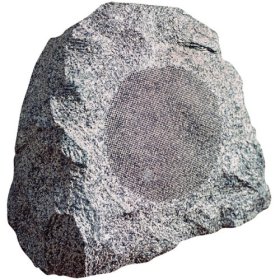
Now, wouldn't a little light Vivaldi add the finishing touch to that garden party you were planning? You can pretend that the string quartet are hiding behind the rockery...
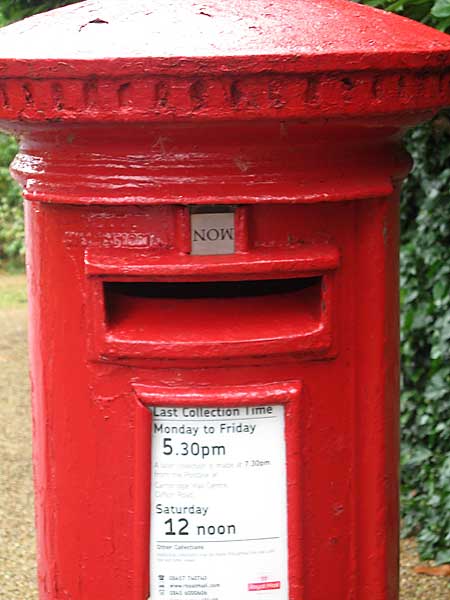
For those not familiar with the finer points of operation of the British postbox, the little metal label just above the slot is changed by the postman on each visit, to indicate the day of the next collection. This one got inverted by mistake, making it appear as if our local service might be rather prompter than usual!
I have very little interest in the Olympics - and strongly object to the hundreds of pounds of my taxes that will be wasted in 2012 - but I do get a regular report of recent events over the dinner table, and a thought occurred to me tonight....
I think there should be a unit of Olympic achievement for countries. We might call it the Apollo. Your Apollo score would be something like the number of medals won divided by the number of your athletes attending and by the population of your country and its GDP. You'd also want to subtract something for the proportion of your athletes who had tested positive on drugs tests in the past...
Rose says it's more complicated than that, because so many athletes do not train in their own country; they get scholarships to US universities, so the GDP of their country is less relevant. And I think an athlete who gets medals in several different disciplines should score more than one who just gets the 100, 200 & 400m medals in the same thing.
So it's far from trivial. The definition of the Apollo would need to be refined over time.
Still, it might make an interesting discussion in the pub. If you wanted a realistic measure of a country's sporting achievement, how would you do it?
Dashed clever, these robotics chaps.
Many thanks to Jason Young for the link.Dinner tonight at the splendidly-named Bar Q. It does Asian-style barbecue (and, by the way, comes highly recommended).
The friend who met us there was asking the waitress how business was going (since so many NY restaurants last only a few months). She said it was good, but the pattern of business changed in the summer because so many people go away for weekends, and she came up, completely seriously, with what I thought was a wonderfully New-York phrase. She said that
Wednesday/Thursday is the new Friday/Saturday