Category: General

Required reading

Well, it should be, certainly for all science journalists, and probably for all science undergrads too. Ben Goldacre's Bad Science is an enjoyable but very well-informed rant about how the media gets science stories wrong, and how to look for the real facts behind the reports.

Ben has a few chips on his shoulder - perhaps a few too many - but that doesn't stop this from being a very important book. Recommended.

Drug houses and DVDs

On the Today program this morning, someone was saying that ISPs should be held partly responsible for movie and music piracy by their users, in the same way that a house owner should be responsible if the house was being used as a drug den.

But surely that's the wrong analogy. People don't in general upload the pirated material to the ISPs' servers - they have it on their own PCs. Holding the ISP responsible is like blaming the local council because their roads were used to transport the drugs. Why not blame the electricity company that powers the PC?

The culpable ones, if any, are those who share material from their PCs. The media industries can't sue all of them, though, so they have to find another scapegoat.

Screentime

From the RosenblumTV blog:

Media Life reports this week that the average American now spends 8.5 hours a day staring at some kind of screen, whether its television, computer or cellphone. ... This means that screenwatching has now become the number one human activity, surpassing even sleep. We will spend more of our lives staring at screens than doing anything else. Screenwatching has become the seminal and defining act of our culture.

Social Spaghetti

  • My tweets are cross-posted to Facebook because I know they'll fit. It doesn't work the other way around.
  • My blog posts can be any size, and are posted to Twitter as URLs, so the links end up on Facebook as well.
  • I guess my Facebook entries could be cross-posted to Twitter as URLs but they aren't usually worth a click! And it could create a feedback loop which would cause my social world to implode.
  • Some of my friends reply on Twitter, some on Facebook, and some on the blog.
  • I get email notifications about blog and Facebook responses. Twitter replies I often miss. I'd like emails from Twitter but am worried that it would be a bit...well... curmudgeonly, like those people who supposedly could only read emails after their secretary had printed them out.
  • Most of my important communications are in Skype IM anyway, which doesn't link to anything!
I wonder what this will look like in three years' time...

Making your Google docs look prettier

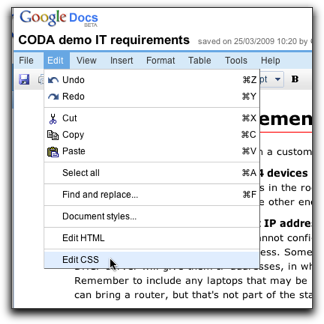
I'm a huge fan of Google docs - especially where several people need to collaborate on a document. But sometimes the formatting capabilities can be a little restricting - margins, line spacing, etc - you have little control over those.

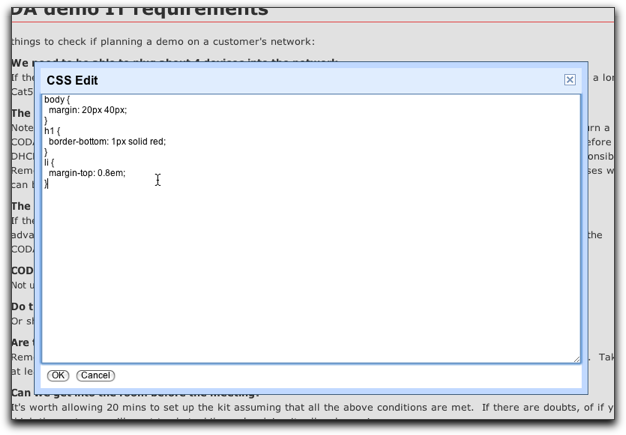
Or so I thought, until this morning I discovered the 'Edit CSS' menu option:

With a little bit of CSS you can change the appearance in all sorts of ways. My needs are mostly simple, though.

Similarly, you can edit the HTML in various ways. I needed a line break as opposed to a paragraph break. Right click and you can Insert HTML at Selection. Type <br /> and you're done.

I hope they teach raw HTML and CSS in schools these days. It's the punctuation of the future. Not that they teach punctuation any more...

Virgin' on the deceitful?

I got an email from Richard Branson this morning. Well, all right, I don't think he personally sat down and typed it, unable to resist the urge to tell me about my particular cable modem connection, but he seemed pretty excited. Here's an extract:

With the launch of our 50Mb broadband this year, the possibilities are virtually limitless. Who knows what speeds we'll be able to bring to you in the future. But rest assured – since you're on the fibre optic network, you're on the right network. With fibre optic technology the possibilities are virtually limitless. On top of almost infinite speeds, there's the simply brilliant things that only fibre optic broadband brings. Right now, you're already getting unlimited downloads and free internet security. But we're about to bring you more.
and he goes on to talk about backups, file-sharing and so on.
All this is possible thanks to the power of fibre optic broadband.
What amuses me is the claim that things like 'free internet security' and 'backups' are only possible over fibre-optic networks, especially when the cable that comes into my house is quite clearly made of copper. I suppose their point is that all those bits of copper connect in the end to a fibre backbone, but isn't the same true of DSL? I guess that a truthful statement might be:
All this happens a bit faster thanks to the fact that our fibre/copper transceivers are placed closer to your premises than most of our competitors' and we use coax rather than twisted-pair for the last bit.
But that wouldn't have the same marketing punch, would it? Anyway - this rings a little hollow at the moment. I've been a happy Virgin Media customer for many years. The service (which they bought from NTL) has been fast and reliable... until a few months ago when things seemed to get somewhat wobbly. And in the last couple of weeks we've had to reboot our cable modem rather too often for comfort. Reports of VM's experimentation with traffic shaping may or may not have anything to do with this, but it's not just my connection - in the office we've gone as far as getting an ADSL line installed to see if that gives us a better connection. The great thing about ADSL, for all its technical limitations, is that it's a more open market. Once the BT man had visited to connect up the wire, we had a choice of who would actually provide the broadband service. It may be a bit slower, but it should be more predictable - we could call up small companies where you could speak to someone who knew about contention ratios, and the effect that different latencies would have on our VOIP codecs. The experiment starts next week, so it'll be interesting to see how it goes. But in our case it may prove that a choice of informed, personal support services was the disruptive technology that even the amazing fibre optic network failed to deliver...

The all seeing, all HEARING Google

Google have announced, but not yet launched, Google Voice, which is an expansion of the GrandCentral service they purchased a couple of years back. Think of it as a cross between your company phone exchange and Google Mail.

I have a GrandCentral account - seldom used at present, as it's very US-centric. But it gives me one US phone number which I can choose to manage in many different ways through a convenient web interface - I can, for example, redirect it to a friend's house if I'm staying with them, or to a softphone, or to a US mobile, or have it ring all of the above and email me a voicemail message if nobody answers any of them.

It's a great service, and GrandCentral users have worried what would become of it since it passed into Google's hands. So I'm pleased to hear that it's being reborn - I hope, and expect, they will now have the resources to make it more international.

And I can't help wondering if this might be a very key component of Android-based phones in future.