Category: General

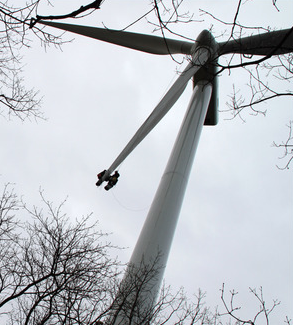
Abseiling before the wind

ropeaccessEveryone who has a hobby must at some point think, "I wonder if I could make a living doing this?"

The NYT has a great article (and video) about a new opportunity being offered by the growth in wind turbines. Sounds like fun!

For this job, though, you may need a certificate from the Society of Professional Rope Access Technicians. There are some wonderful organisations out there, don't you think?

Regressive progress?

I forget who said that the great thing about the mobile phone network was that it had lowered people's expectations of telephony to the point where internet calls were now feasible...

I couldn't help thinking of this while looking at the map of the UK's planned switchover to all-digital TV. When I upgraded my aerial a couple of years ago to allow me to do digital stuff, it made such a difference to my analogue picture that the digital signal, while good, is now definitely inferior. And I have a top-line TV with a high-quality digital tuner, but I am still aware of slight digital artefacts which are more annoying than any analogue noise. Most of our TV-watching is, actually, digital, because we store everything to disk and watch it later, but on the rare occasions when we watch anything live - during Wimbledon, for example - we always prefer the analogue signal. This is because I now have very good reception, but ironically, people at the other extreme - in remote far-flung parts of the country with very poor coverage - will have the opposite problem of not being able to get a digital signal at all.

Often, apparent drops in quality can be explained by Clayton Christensen's idea of disruptive technology: examples include audiophile hi-fi CD systems being replaced by MP3 players, gigabit ethernet connections proving less popular than wifi, and so forth... The original metric that was used by customers to judge a technology's value is suddenly replaced by a different one and all those who had striven for constant improvement on one axis suddenly have to change direction. The companies that can move fast are generally the winners.

That's not really the case for the Digital TV switchover. With classic disruptive technology examples, it's generally the customer who suddenly realises that he wants something different from technology and is willing to put up with a compromise elsewhere in order to get it. Here, it's not clear to me that many consumers really want digital TV; this is being driven by the industry, which will make it a much harder sell. And it means that it's the responsibility of the industry to provision the system appropriately so that customers aren't let down by 'progress'.

I'm still keen on the switch to digital, because I know what it will let me do on my hard disk, and I appreciate the value of reclaiming large chunks of the frequency spectrum. For me, these are a higher priority than smooth high-speed motion when watching sports footage. But I can't help feeling I'm probably in a minority here!

Still, perhaps the great thing about YouTube will prove to be that it lowered our expectations of video to the point where terrestrial digital TV was not too much of a let-down.

RSS to Mail

If you're not very good at checking your RSS feed reader, but understandably can't bear to miss a post on Status-Q, you could try a service like FeedMyInbox, which takes RSS feeds and send them to you by mail. Seems to work very nicely.

You can sign up for Status-Q feeds here:

Email Address:

Powered by Feed My Inbox

There's no place like Chrome

Sometimes, just sometimes, I wonder whether I'm getting a glimpse of the future. I wondered that about the early Google Wave videos, but, so far at least, for all the technical cleverness, the future leaves something to be desired. We shall see.

On the subject of Google, though, this post may or may not turn out to be a momentous..errm... moment for me. Because this is the first thing I've written using their Chrome OS. I'm running it on my Acer Inspiron One netbook, booting from a USB drive using the very handy images created by a student known as Hexxeh, who seems to have been such a success that his site is currently down.

So far it's been very easy to get going, amazingly fast to boot even from my elderly USB stick, and pretty nice to use.

Something tells me this may not be the last post I make using this system...

More from TED

Two great TED talks for you this morning: Richard Dawkins, speaking in the States, on atheism, especially in the context of American politics. Hans Rosling, speaking in India, on the rise of Asia - statistics doesn't get much more fun than this. Both of these are both very funny and very informative, and made more relevant because of the audience in each case. You can use the search box on the right to find some more of my past recommendations from the same speakers.

Sent to Arcadia

Coventry isn't as bad as you might think. No, really, it isn't. I worked and lived in the city for over a year just after school and, as far as I can remember, it was just fine. On the other hand, I was young, and hadn't much experience of living anywhere else, so maybe I just didn't know any better. I can't say I've ever felt a yearning to return...

Well, I'm back again now, manning an exhibition stand at the Ricoh Arena in an unfashionable area to the north of the town. The last time I did the exhibition stand thing was at Olympia - a very much larger event in a very different venue. Then, as I recall, I paid a lot of money to stay in a room so small that putting your suitcase on the floor meant you could no longer walk around the bed.

So what about here?

Here, my exceedingly affordable room is quite a bit bigger than my bedroom at home. It contains a large brass bed, a sofa and a comfy chair or two. An antique wardrobe and an oak chest sit next to the fireplace. I am, in fact, in one of the nicest B&Bs I've ever stayed in, a 17th-century haven in the middle of a couple of hundred acres of dairy farm, run by a delightful couple. I can park easily under the trees outside, and the cows gazed thoughtfully at me as I headed out this morning on my way to the exhibition.

So how long did it take me to reach this rural idyll from Coventry's manufacturing heartland?

Twelve minutes.

Beat that, London.

Improving the RUI - the Road User Interface

The great thing about travelling, I've always thought, is that it makes you realise what you've always taken for granted at home. Do light switches go up or down to turn them on? Or do you press them in so that a timer can pop them out again when you're halfway up the stairs?

One thing I noticed when first visiting the States was how much text is used on road signs compared to here at home. We tend to assume that symbols are better and so will create some complicated series of hieroglyphics to indicate that the road narrows and then turns left, while an American sign would probably say "Road narrows then turns left".

Symbols do have an advantage if drivers are illiterate, dyslexic, or foreign. And they usually take less space. But they need to be used well. Here's a sign I pass regularly which, I find, takes some thought:
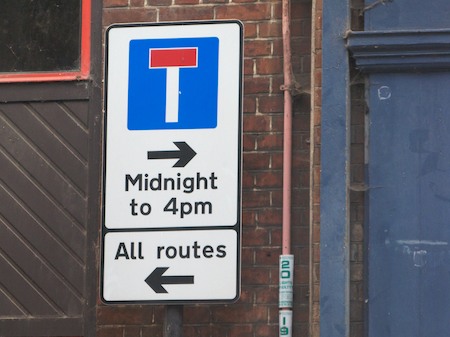
Cambridge road sign

It faces you as you come to a T-junction, so you at least have time to contemplate it, which is fortunate - it would be more challenging at speed!

For me, as I suspect for many people in this situation, the question I am asking is 'Can I turn right?'. To the right is a useful route that takes you away from the crowded centre of Cambridge where you've just been parked. But it is blocked, a little way down, by bollards which let traffic either in or out of town at different times of day. So what this sign says is that you can always turn right or left, but turning right will lead you to a dead end at certain times. Fine.

However, if you arrive just after lunch thinking, "Can I turn right?", you see the arrow pointing that way, you see the times, you work out whether you are in that midnight-to-4pm slot and then you think "Hurrah!", before realising that you've worked out the times when you're not allowed to do that.

I don't know, maybe it's just the way my brain works that's strange. Or maybe it was designed by some local logicians to keep people like me on their toes. I think it's a Microsoft road sign. Lots of different ways to do things and some of them unnecessarily complex.

How would Apple design this? I think the sign would just have a single elegant left arrow. They'd say, "Sorry, that's the only way you can go. No right-button clicks here. I know that seems restricting, but trust us, it's for your own good. And doesn't this sign look beautiful?"
Alternative medicines

There's a nice saying which captures the fundamentals of alternative medicines:

If they worked, they'd be called 'medicines'.

Over the centuries, medics and academics have carefully examined herbal and folk remedies and the ones that actually did anything useful became part of the standard medical toolkit. The ones that didn't are now labelled 'alternative', though they can of course have a useful placebo effect.

Anyway, I liked this article about an alternative remedy store in Leicester. Nicely done.

Thanks to Sarah McKeon for the link.