Category: General

Topic of the weeki

Everybody's talking about Wikileaks, so in general, I haven't. People like John are doing a much better job than I ever could.

There was some discussion on a couple of the Twit.tv podcasts about the heightened emotions directed at Wikileaks itself, though, and I thought they came to some sane conclusions, which were roughly as follows:

  • The person who committed a crime was the original source, who is now being dealt with by the law
  • Wikileaks did no more than any newspaper would have done if it got its hands on the material, and is no more or less culpable than the New York Times and the Guardian and others who have been republishing it.
  • Wikileaks just did it more efficiently and for different, and some would argue, more honourable, motivations than a newspaper's. [This is the real novelty. People know how to interpret newspapers' actions.]
  • Those hackers attempting to target organisations that failed to support Wikileaks are guilty of suppressing the kind of freedoms of speech and action for which Wikileaks stands.
  • The big danger is that any measures brought in to 'deal with' Wikileaks could be used against the New York Times and the Guardian in the future.
That seemed to me a pretty good executive summary, but what a lot of fun debate is going on about these, and all the ramifications, especially as initial outrages give way to more careful considerations. They're all missing the real question, of course: who will play Assange when the movies start to come out?

Seeing the future?

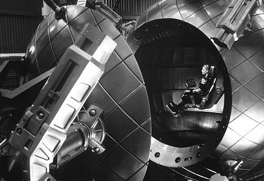
One of the first DVDs I owned - indeed, I think, one of the first released in the UK - was 'Contact', which stars Jodie Foster in Carl Sagan's story about the first communications with extra-terrestrial intelligence.

It's a fun film, and I hadn't watched it for a while. But I've just discovered that amongst the 'special features' are several full-length commentaries, something which was quite a novelty back then.

One thing that tickled me while listening to the Director and Producer's commentary, apart from the nostalgic shots of Netscape in use and the fact that 'Web' was always prefixed with 'World Wide', was the moment when a flat-screen TV made its appearance.

'Look at that screen!', they say, breaking off from their discussions of intergalactic travel. 'That's a real TV... We aren't overlaying those pictures... See how thin is is? You could hang it on your wall!'

Curiouser and curiouser

Here's an excellent Nature article by Ahmed Zewail. Extract:

Some believe that more can be achieved through tightly managed research -- as if we can predict the future. I believe this is an unfortunate misconception that affects and infects research funding.

I've always liked Einstein's comment that "if we knew what we were doing, it wouldn't be called research".

Veni, vidi, wiki?

There's a good post on the Economist blog about the WikiLeaks affair:

My gripe against Mr Assange is that he takes advantage of the protections of liberal democracies, but refuses to submit himself to them. If he wants to use the libel protections guaranteed by New York State, then he should live in New York, and commit himself to all of the safety and consequences of America's constitution. If he wants to use Sweden's whistleblower laws, then he should return to Sweden and let its justice system take its course.

It's a bit of an over-simplification: if you're an an anarchist, where should you live, since we no longer have Australia set aside for that purpose? But it's basically a good point.

This makes me think of the observations by Dawkins et al that those who will flatly deny the validity of the scientific process when it challenges their view of the creation of the earth, or the efficacy of alternative medicines, will then happily get on a plane to fly home, where every minute of their very lives depend on hundreds of years of that same process.

This is the point at which, by the way, if you haven't seen it, you should watch Louis CK's comments on 'Everything's Amazing and Nobody's Happy':

Anyway, back to WikiLeaks: The other thing that bugs me is that the feeling that some of those who revel most enthusiastically in the WikiLeaks revelations would be those who would protest most loudly if their own privacy were compromised.

Just as 'superstition' is often the name we use for somebody else's religion - and they for ours - so 'freedom of information' is often the name we give to invasion of someone else's privacy, and, one day, might be used for invasion of ours.

Be careful what you wish for... You may get it!

Update: I should perhaps emphasise that I'm an advocate of freedom of information in general! But we're starting to hear stories which remind me of what we've seen with the Human Rights Act in the past: the more such good intentions get formalised into legal structures, the more people come to think of them as unassailable rights in all circumstances, and the more they can be misused by those wanting to make a quick buck or write a sensational story.

Brand confusion

An elderly colleague turned to me at lunch yesterday.

"Tell me", he said. "you're a computer expert... All of these leaks must mean that nobody in government will be able to use email ever again. Just what are the political motivations of an organisation like Wikipedia?"

Traditional grid system

One of the monthly invoices I get by email (from those nice people at VoIPtalk) starts with:

Please view this with a fixed-width font.

And indeed, all the columns line up much more tidily if you do that, but come on, chaps, times have moved on! Even people like me are no longer using Pine to read their email, and you can bet that the vast majority of your customers won't even know how to set their email reader into a fixed-width font.

Ironically, if you want people to view your message in Courier nowadays, you probably need to send it as HTML!

Against the grain

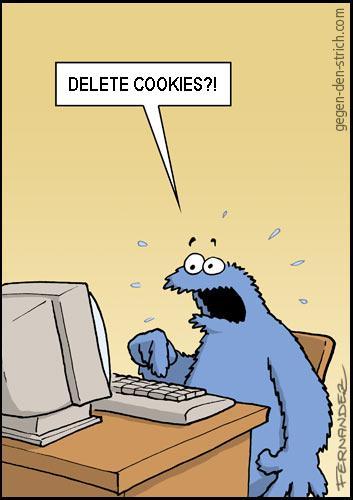
Just discovered Miguel Fernandez's site, Gegen den Strich, which, if my decidedly rusty German is to be trusted, means 'Against the Grain'.

Miguel is a cartoonist, and, though the site is in German, a fair selection of them will work across linguistic boundaries. I like these:

This is one of his, but doesn't appear to be on his site at present:

Thanks to Nick van Someren for the original link.

Take that, Powerpoint!

Dennis Dutton's TED talk on an evolutionary theory of beauty is very interesting in its own right, but it's also illustrated by Andrew Park in a phenomenally clever way.

This is about as far from slides full of bullet points as you can get. Wonderful stuff. Worth watching full-screen...

Oh, for a beaker 1/4-full of the warm south...

It seems to me that beverage manufacturers have cottoned on to how profitable homeopathy can be.

Bottled drinks seem increasingly to be pure water with hints of flavour or claims of added vitamins. And the more dilute they are, the more they cost. Isn't it wonderful that the language provides us with positive words like 'purity', indicating the absence of anything else? A marketer's dream...

[Aside: I had a drink today which boasted about its levels of antioxidants. People should know by now that antioxidants are not necessarily a good thing...]

Anyway, I sometimes wonder if you could take it to extremes and leave out the water?

I think I'll try that. I'm going to start a company which sells vacuums in little containers. It won't be a total vacuum, of course, because we know nature abhors that, and it must, of course, be Natural. It'll be a vacuum which echoes the purity of the outer edges of Earth's atmosphere. There'll be a few oxygen and nitrogen molecules in there, just the way nature intended...

You can take it home, open it up and release a little bit of outer space into your room. Breath deeply, focus on your inner energies, and meditate on starlight...