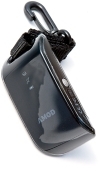
I have a geek-detecting device. It's a small black battery-powered oblong which dangles from my belt hook, and enables me to discover a great deal about the geekiness of people I meet, often in a remarkably short space of time. But there's a bit of a story behind it, so let us begin at the beginning...
When I worked at AT&T Lab here in Cambridge, one of the projects involved in-car computers, which we linked to SMS gateways, GPS receivers and a variety of other things. This was long before TomToms hit the local Halfords, and a computer in a car was a fairly unusual thing. We ran software which captured our GPS coordinates every second and saved them to disk, with the result that we started to build up quite an interesting set of data about how fast people actually travelled on a particular road at 4pm on a Friday afternoon, for example. But it was also fun just to have a record of where you'd been. Time, however, moved on - the lab closed down, the project was disbanded, and the computer was stolen from my garage when I was between two cars. Ironically, I never found out where it went...
Well, a few years ago, it occurred to me that at some future point in my life I might find it interesting or useful to have a record of my movements, in the way that I used to have back at the lab. Maybe I hoped that one day Hercule Poirot would turn to me and say, ""And where were you, monsieur, on the night of the murder?"", to which I could reply that I was at 52.249 degrees north and at 0.408 degrees east, and would therefore be visible in the footage recorded by the CCTV camera outside Woolworths. Or perhaps it was stories like the one a few years ago about a chap whose speeding ticket was revoked because he successfully argued in court that the GPS tracker in his car, pronouncing him innocent, was rather more accurate than the police's radar speed trap.
Of course, it's the things that you can't predict that often prove to be the most interesting. As Einstein said, ""If we knew what we were doing, it wouldn't be called research!"" And whatever the long-term potential, I realised that if I didn't capture this data now, I'd never be able to get it back again in future.
And so it was that I purchased an AMOD GPS logger and clipped it to my belt. There are several GPS logging devices on the market but I liked this one because it doesn't require any special software to read the data - you just plug it into a USB port and it appears as a storage device with plain-text NMEA log files. I have a set of scripts which copy them automatically into a Dropbox folder when I plug it in, and perform some filtering and conversion on the results.
This, then, is my geek-detecting device.
When I tell people that I like to record everywhere I've been, just in case I would ever like to look it up in future, some people look puzzled and just say, ""Why?""
Some see it as sinister, and ask if I'm not worried about being tracked by the government / the CIA / the boss / the Googleplex / the wife. (It's actually quite revealing to see which of these first strikes them as a sinister entity. I can't help wondering if my life would be more exciting if I did have a desire to hide my location from one, or perhaps several, of them...) But I point out that this is not a live tracking system - the mobile phone in their pocket is much better for that. This is about logging data for my own use and it isn't available to anyone, even me, until I get around to syncing the device to my PC, often several days later.
But then there are others, who get it immediately, and respond with "Cool!" or some similar phrase, at which point I know I have found a kindred spirit. You see, you can take the geek out of the research lab, but you can't take the research lab out of the geek...
Anyway, all of this means that I can tell you, for example, that exactly three years ago today I had a meeting in London. That's nothing special - my online diary also records that. But what it doesn't record is that I took the 10.15 train from Cambridge, via Stevenage, and that it was about 5 minutes late arriving at King's Cross. Nor that after the meeting we lunched in a little street just off Marylebone Road, and that I arrived back in Cambridge at 15.09. (I had parked at the far end of the station car park). I drove from there to the office, which, because of the time of day, only took 12 minutes, and I finally returned home at 7.38pm. This particular day may not excite you. It didn't excite me. But it's still kind of cool to know so much about it...
The main advantage of knowing roughly where I was at any given time, though, has been for my photography. By matching the timestamps from the GPS with those of my photos, I know where each of my shots was taken. I can easily revisit the location of a dramatic view, a comfortable B&B, a cozy restaurant, even if I have no other record of it. I can find all the photos I've taken of Ely cathedral, though they were taken on numerous visits. And so forth. This is the main aim of (and market for) these units; many people clip them on when going for a photo shoot or a long hike. But the disregard for sartorial elegance which allows me to wear it every day, combined with a carefully-developed battery-charging regime, means that I almost always have this information for every one of my photos, no matter what the occasion, or which camera I was using.
The system is far from perfect, of course: there are large chunks of many days for which I have no record, because I was inside a substantial building, or forgot to wear the logger, or because its batteries or storage had run out. I decided right at the start that this needed to be something I would clip on and forget, rather than a precise record over which I might fret every day. So I don't have everything.
But the 92 million data points I've captured over the last three and a half years makes for an interesting start...

 I like Clayton Christensen. He oughtn't to be an interesting speaker, by many of the standard metrics: he speaks slowly and haltingly, he stumbles over words, and he uses unexciting slides with little aesthetic appeal. And yet I think he's brilliant.