Category: General

Is a picture worth 140 characters?

thumbI sent an emoji today. Not quite my first, because various systems have been converting my colon-dash-parentheses into smiley or sad faces for some time, but I think it was the first time I've deliberately sent one knowing the recipient would see it as a picture.

In this case, it was a 'thumbs up', which I sent to John Naughton in reply to an incoming query, because I had my hands rather full at the time, and I could at least do that with a couple of taps on my watch. I guess they're useful for that level of communication when you don't have access to, say, a keyboard.

In general, though, I'm rather confused by this apparent belief that a return to hieroglyphics is a good idea, and that people are willing to send messages expressing emotions when they often have little idea of what the receiving party will actually see - this may be rather different from what you thought you sent. At least we didn't have that problem with the clip-art of the 90s... and it still went out of fashion.

This is the way our communication technologies progress: first, we neglect spelling and grammar. Then punctuation goes by the board. Now we can abandon words altogether, and start using other people's primitive pictures. Soon, I imagine, the internet will give us a way to say "Ug" while hitting each other with jawbones.

Still, for better or worse, Apple and others feel the need to issue complete operating system updates where new and improved emoji are the main feature. Did you know, for example, there is now an official unicode character for a man-with-slightly-dark-skin-getting-a-face-massage? It's hard, looking back, to conceive that Proust, Hemingway and Dickens were all able to communicate so effectively when their character set didn't include any face-massage symbols at all!

Still, if you want to know everything there is to know about the wonders of this new alphabet, then Emojipedia is a good place to start. And because they are actually official unicode characters, you can even use them in, say, URLs. This is completely valid, though your browser might not yet think so.

http://emojipedia.org/emoji/ðŸ'†/

Try giving that address to somebody over the phone! Ah, but I guess the youth of today are unlikely to do that, because using a phone would also involve using words...

Altruistic Autonomous Vehicles

One of my shortest recent posts generated quite a lot of discussion, both here and on Facebook. I wrote:

When we have proper and affordable self-driving vehicles, will that be the end of the railways?

Clearly there are some things that railways will do better for the foreseeable future, like long-range high-speed links, or carrying heavy freight. And don't get me wrong: I like train journeys. But it seemed to me that the key reasons people currently take trains for normal day-to-day journeys -- wanting to read en route, a lack of parking at their destination, avoiding congestion -- could very soon be overcome when, for example, your car can go and valet-park itself after dropping you off at the office.

And the disadvantages of train travel: the fact that instead of going from point A to point B, you have to go at least from point A to point B to point C to point D, possibly waiting on a cold platform at point B for an indeterminate period, and not being sure whether you'll get a seat from point C to B on the return journey. Will it be worth the hassle?

One of my assumptions is that traffic congestion will become less of an issue when cars are smarter, of course, which may not be a valid one, especially if lots of train travellers take to their cars instead.

There's an interesting question as to whether lots of small independent agents trying to meet their own goals are going to result in an optimal solution for road congestion as a whole. We may start off with vehicles that are pretty autonomous initially, but become less so in due course, as the road infrastructure starts to adapt to them. Network packets on the internet know their destination, but it's the routers (the junctions) that tell them which exit from the roundabout to take.

Will the Department of Transport manage overall use of the network better than each individual car? Well, that depends on who has the better computer scientists, of course! But it also depends on the amount of knowledge each vehicle can get about the overall road network, and, of course, on how selfish your car is: will it decide that the needs of the many outweigh the needs of the one (or the few)?

Perhaps we need Altruistic Autonomous Vehicles? (You heard it here first!) There could be financial incentives to encourage this. You get lower road tax if your car agrees to obey centrally-prescribed rules at times of high congestion. Perhaps you get to use the high-speed autonomous-only lanes if you're willing to hand over to the cloud-based algorithms. Of course, this could open up all sorts of wonderful opportunities for hackers, too. Remember the movie?

Anyway, perhaps congestion will be less of an issue, but for a completely different reason. If you can be having a coffee, working on your laptop and taking Skype calls while you slip quietly along in your electric car, you may be more productive than if you'd got to the office on time.

Fall from Olympus

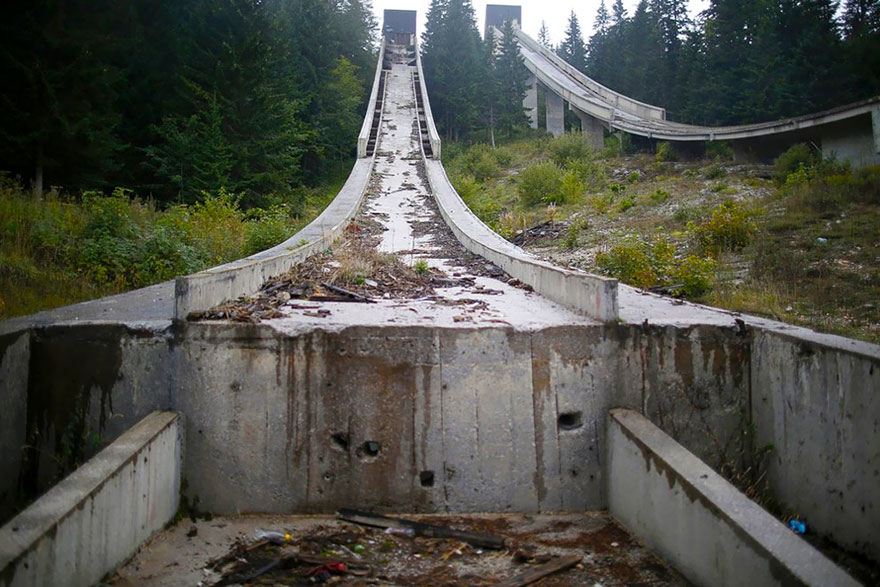
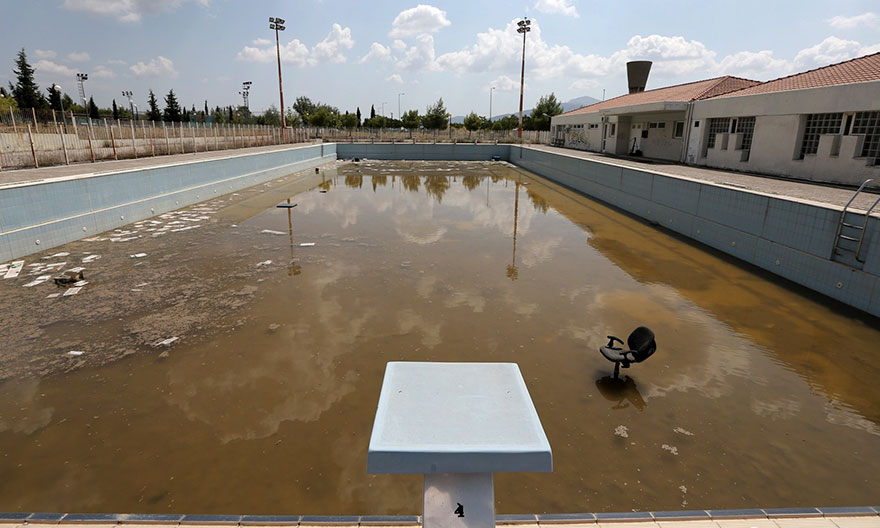
I've written elsewhere about the cost of the Olympics, so was struck by this poignant sequence of photos of former Olympic buildings, and this one found via Jessica Bloom's article here.

Sarajevo ski jump

A Sarajevo ski jump

Admittedly, these images are mostly from places that have been through difficult times recently. I've visited various Olympic stadia over the years -- Munich, Montreal, one or two others -- and have been struck by their complete emptiness and eery silence, but I don't think were in the state of disrepair that seems to beset Athens. It's ironic, really; the Greeks used to be quite good at this kind of thing!

QVqCplC

An Athens swimming pool

I still haven't seen any of the London Olympic facilities (not even on television) because I was a bit busy when the games were on, but perhaps I should go and take a look before they end up like this. On the other hand, they'll probably make more interesting photos in a few years' time :-)

Today

It occurs to me that if I were to suffer a minor injury today, perhaps through careless use of a carrot-peeler or (more likely) a soldering iron, it would have the compensation that thereafter I could strip my sleeve and show my scars and say, "These wounds I had on Crispin's day!"

Almost seems worth it. Especially if some of my friends would agree to hold their manhoods cheap in consequence...

On recycling...

We've been doing a big clear-out recently, and have got rid of a lot of stuff, and there's more to go, to the extent that I've developed a strategy for getting rid of things.

Here, for what it's worth, is the Status-Q guide to a more minimalist lifestyle, tuned somewhat for the Cambridge area:

If... Then it goes to...
Nobody likely to want it/impractical to get it to them Local dump/recycling centre
Somebody might want it enough to come and pick it up Freecycle group (now via TrashNothing.com)
Somebody local might want it enough to pay something for it, or, it would be tricky to ship. Gumtree
Somebody might want it enough to pay something for it, but probably not the sort of people who read Gumtree. Nearby charity shop.
Somebody might want it enough to pay something for it but probably not the sort of people who read Gumtree, and it's electrical. British Heart Foundation shop, or the local Emmaus community.
Somebody might be willing to pay more for it, but they're harder to find locally. eBay

There are, of course, variations on this theme, and many tricks of the trade.

  • How do you know whether people might pay a reasonable amount for it, or what might be a reasonable amount to ask? Go to eBay and search for the closest thing you can find, then select the option on the left that says 'Show only... Sold listings'.
  • I'm fortunate to have a Post Office very close by, but for anything larger than, say, a book, a courier is generally cheaper these days. I recommend Parcel2Go as a quick way to find a cheap one.
  • Packing stuff for shipping can be a pain. If you know you're going to be doing this, hoard your cardboard boxes and bubblewrap for a while beforehand, or find a local store and ask them to keep some for you. Buy yourself a proper packing-tape dispenser and lots of tape. Even the basic dispensers can work well. Big Jiffy bags are also useful.
  • If you want to get rid of stuff quickly, you can try more than one method in parallel. You can put stuff on Gumtree and eBay simultaneously, for example, until you get a bid on eBay. Somebody local might show up first and save you the problem of shipping.
  • But often, things go in series for me. Nobody local want it? Try eBay next. Then with international shipping options. Nobody want to pay for it? Try giving it away.
  • Oh, and you know the stuff we used to call bric-a-brac? It has a new name, now: vintage. Try sprinkling that through your advertisements...

Sometimes you get pleasant surprises. The old HP calculator that's been gathering dust on my desk and getting in the way for a few decades turned out to be a collectible item, and has just sold for £56! In spite of donating quite a lot of it to charity, I've made about 400 quid over the last few weekends by getting rid of stuff I wasn't using, and gained a lot of floor space as well.

But, really, it's not about the money. It's about not wasting stuff when somebody else would value it more than you do. I've been finding decluttering refreshing and liberating, even though some of the items had sentimental associations. Mmm. Perhaps getting rid of those is actually the most liberating?

Making every second count: 29.97 FPS

If you've done any serious video work, you'll know that European TV runs at 25 frames per second, essentially because early TVs used the frequency of the mains power supply, which is 50Hz, while in America, where the power is at 60Hz, TV runs at 30 frames per second.

Except that it doesn't.

It actually runs at 29.97 FPS in the States. You don't need to know this if you're just creating YouTube videos, but is very important if you're doing serious TV production and you don't want your hour-long documentary to have the vital last 4 seconds chopped off. Over a day of TV programming, these little discrepancies all add up, so you need to get it right.

So, why 29.97?

Matt Parker has made a very nice little video explaining how that number came about.

Now, cinema film is generally shot at 24fps, which was chosen as a nice compromise between having smooth motion and not using too much film (or having to change film reels too often). It also makes for nice round numbers of frames if, say, you need to make something quarter of a second shorter by taking a razor blade to your footage.

However, in fact, movies no longer use that nice round number either! Why not? Well, when you want to broadcast movies on television, you do so via a process that involves converting two film frames into three TV frames, which again gives nice round numbers if you're going from 24 to 30. (More info here.)

But we know that TV actually runs at 29.97 FPS, and as a result, most cinema film is actually recorded at 23.976 FPS, to make that conversion process still work smoothly.

So that's where those funny numbers come from, in case you were wondering. You can now impress your friends in a pub trivia quiz...