Posts from June 2008

Technology quiz

Here's a question for you. Which company was responsible for building the first business computer?

IBM, perhaps? Data General? DEC? or Lyons (the British tea company)?

Yes! Well guessed! It was Lyons.

The New York Times tells the story of David Caminer, who worked with Maurice Wilkes to create the LEO, and who died this month.

Mobile thinking

Gordon Brown said recently that improving social mobility is a "national crusade" in which Labour has not made enough progress.

I thought the BBC's The Week In Westminster programme had some interesting comments from Matthew Taylor, a former advisor to Tony Blair:

I think we should be more critical than we are about the concept of 'social mobility', and I think we should set it against the concept of 'equity'. You can have a society which is socially mobile but very unequal; you can equally have a society that isn't terribly mobile but where there are high levels of equality, and probably, the evidence suggests, the thing that makes us content overall as a society is more equality than it is mobility, because the pure concept of social mobility means that for everybody who goes up, someone comes down, and generally speaking we're more frightened about coming down than we are excited about going up. Politicians talk about social mobility because it's so much easier to talk about than 'redistribution', and because people only understand social mobility as an 'upward' concept. If people really thought through was was meant, for example, by a society that was quite happy to let unintelligent middle-class children not succeed then I think people might not see this concept through such rose-tinted spectacles.
For the next few days you can hear the interview here. This segment starts around 21:56 mins in.

Build version numbering with Git

The 'Git' version-control system is used to develop the Linux kernel, amongst other things, and it's the most powerful one I've used. (And I'm old enough to remember SCCS :-)) It takes some work to get your head around Git, but we're now using it to develop our CODA system, and it's been well worth it.

Michael came up with a nice way to number our build versions and has written it up on his blog - might be of interest if you're using Git already.

If you aren't, Randall Schwarz's talk is a good intro.

Noblesse n'oblige pas

Ian Walker quotes this delightful snippet from the Metro:

Lords: Give green light to Segways Scooters known as Segways should be allowed on the roads, peers said yesterday. The electric two-wheelers got the backing after peers tried them out.... Segways are used by police and the public in parts of Europe along with the US. There have been concerns here about safety. But [Liberal Democrat] Lord Redesdale said: 'I drove one straight at Earl Atlee and failed to do him any damage at all.'

Firebug

For those of us who do web-based development, Firebug must be the single most useful tool invented in a long time. I've used it for ages but I keep discovering new stuff it can do.

If by any chance you haven't discovered it yet, go and get it now - it's free. Any time spent learning your way around it is definitely going to be worthwhile. For some more advanced examples, you can watch Joe Hewitt's talk, given last year at Yahoo.

Segregation

The polarisation of American politics is a common subject of discussion. A recent Economist article suggests that "Americans are increasingly choosing to live among like-minded neighbours. This makes the culture war more bitter and politics harder."

Where you live is partly determined by where you can afford to live, of course. But the ""Big Sort"" does not seem to be driven by economic factors. Income is a poor predictor of party preference in America; cultural factors matter more. For Americans who move to a new city, the choice is often not between a posh neighbourhood and a run-down one, but between several different neighbourhoods that are economically similar but culturally distinct. For example, someone who works in Washington, DC, but wants to live in a suburb can commute either from Maryland or northern Virginia. Both states have equally leafy streets and good schools. But Virginia has plenty of conservative neighbourhoods with megachurches and Bushites you've heard of living on your block. In the posh suburbs of Maryland, by contrast, Republicans are as rare as unkempt lawns and yard signs proclaim that war is not the answer but Barack Obama might be. ... Because Americans are so mobile, even a mild preference for living with like-minded neighbours leads over time to severe segregation. An accountant in Texas, for example, can live anywhere she wants, so the liberal ones move to the funky bits of Austin while the more conservative ones prefer the exurbs of Dallas. Conservative Californians can find refuge in Orange County or the Central Valley. Over time, this means Americans are ever less exposed to contrary views. In a book called ""Hearing the Other Side"", Diana Mutz of the University of Pennsylvania crunched survey data from 12 countries and found that Americans were the least likely of all to talk about politics with those who disagreed with them.

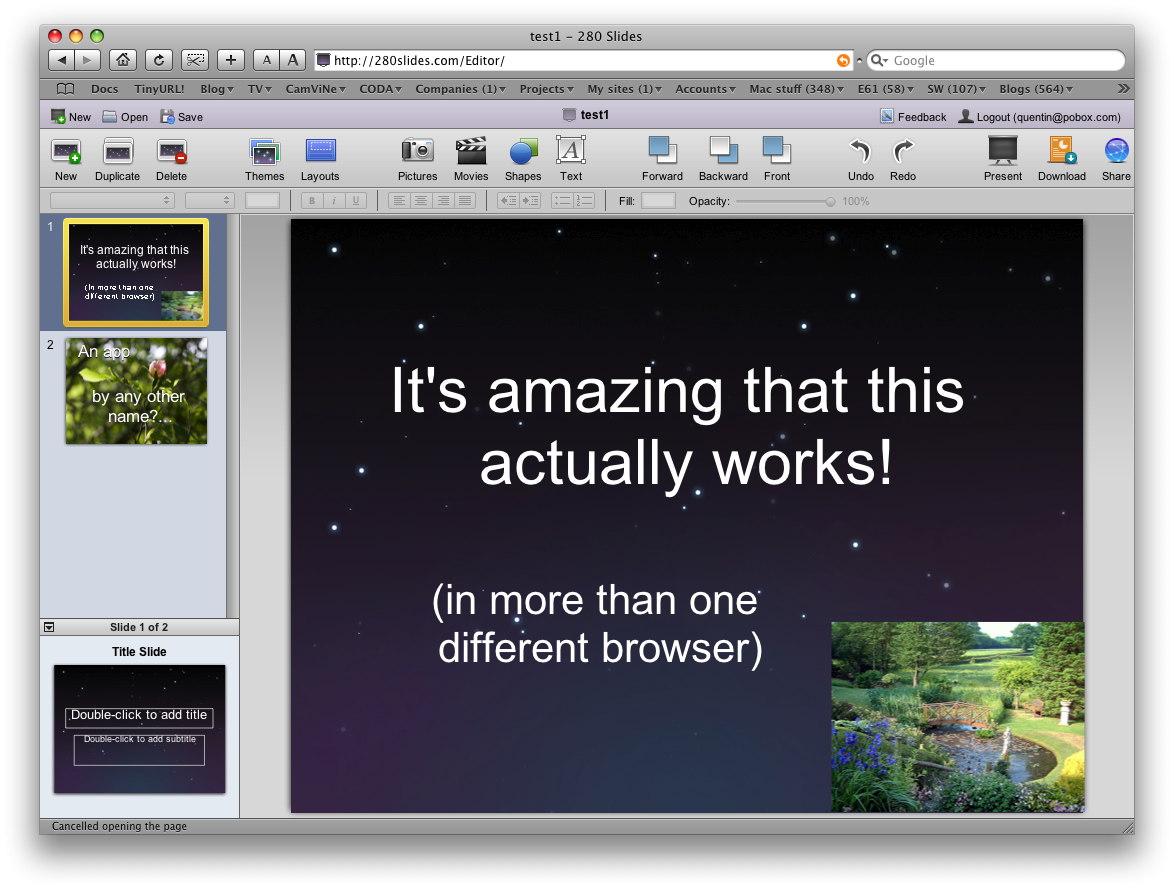
280 Slides

A small group of developers at 280 North Inc (I think there are three of them) have shown that you can do some pretty impressive stuff within a browser if you work hard enough at it.

Their 280 Slides application is a Powerpoint-like presentation package which does a lot of things that you'd only expect a desktop app to do, and it's written in Javascript, not Flash.
Mind you, 'written in Javascript' doesn't really explain enough; they wanted to build a framework for creating such apps based on their good experiences with Apple's Cocoa, so not only did they have to recreate much of the Cocoa API (their version is called Capuccino), but they also needed to create Objective-J, which brings to Javascript the features that Objective-C brought to C. So the browser first loads a preprocessor which can handle the '.j' files in which the app is actually written.

Some may say this constitutes trying a bit too hard - a browser isn't an operating system, after all - but it's pretty impressive that it works, and works in several browsers.

More info in an interview here.

One day, the browser will be your operating system, and then this will all seem completely normal. :-)