Car Karma
I like Claes-Frederik's ideas on a way to reduce road-rage and make traffic more friendly.
Quentin Stafford-Fraser's blog
One should always have something sensational to read on the net...
I like Claes-Frederik's ideas on a way to reduce road-rage and make traffic more friendly.
Normally, I detest VPNs. They're a good idea in theory - make you look as if you're on your office network when you're somewhere else - but my experiences of them at three different organisations has not been good. Fortunately I'm geeky enough to find alternative solutions using things like SSH, VNC, SFTP and WebDAV, which generally have performed much better. These days, though, if you have many mobile workers, it can be better to put your company services out there on the internet (with appropriate security measures, of course) where they can be accessed from your own network and from elsewhere.
However, more peer-to-peerish solutions like Hamachi could be very useful if, say, you want to back up your mother's PC or print on your brother's printer. As well as Windows support, there are console versions for Mac and Linux, and a new version with a GUI for Mac OS X.
Disclaimer - I haven't tried any of these. Just an interested observer.Most ordinary users don't need their digital camera to have more than about 3 or 4 megapixels. Even at that point, the quality of the optics is more important than the number of pixels.
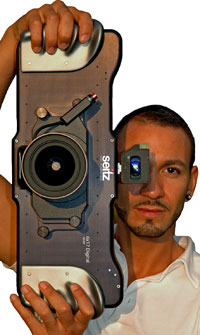
But those who disagree with me, or who aren't ordinary users, might be interested in the upcoming offering from Seitz:

At 160 Mpixels, taking nearly a GB per image, it dispenses with flash cards and uses a Mac Mini in a satchel instead.
But any temptation I might have had to splash out 29,000 euros on one of these vanished when I realised that it wouldn't quite fit in my pocket.
Thanks to Frank Stajano for the link.I don't know about you, but I'm always sending Google Maps locations to people who are coming to visit. I usually type in my postal code and send a link to the resulting map, with a bit of explanation:
"Here we are. Well, actually, we're not quite here, we're at the end of the street and on the other side of the road, but this should give you an idea of how to find us."
I wanted to do something better than this, and while I knew all kinds of sophisticated things were possible with a bit of Javascript and the Google API, I just don't have the time to play with this at present, much to my chagrin. So here's my quick guide on how to create a useful, short URL that will really tell people where you live, and will take them to something like this:
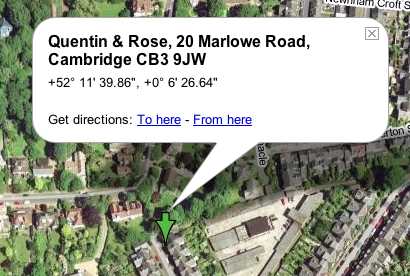
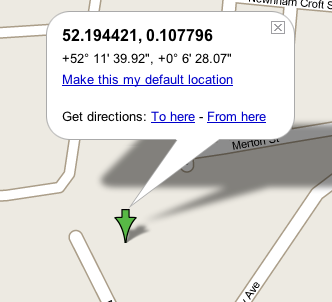
Here's how I got this:
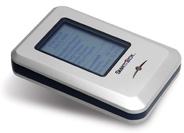 The new FireLite Xpress is a portable hard drive with a difference.
It has a cholesteric LCD display on the front.
The new FireLite Xpress is a portable hard drive with a difference.
It has a cholesteric LCD display on the front.
These displays are generally low-resolution, monochrome and exceedingly slow to update. So what's their raison d'être? It's this: once the image is on the display, you don't need any power to keep it there. This means that they can be used for static information on things which don't have a battery.
The display can be set to show a variety of useful stuff - the label of the disk, the amount of free space, the date it was last updated, and so forth. Just under 100 quid in the UK. A very nice application of the technology.
Here's a site which does a simple job but does it rather nicely:
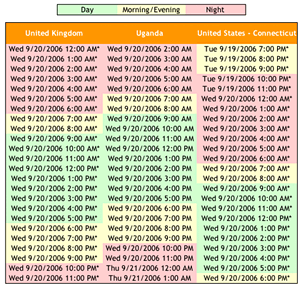
It helps you work out the best time for phone calls or videoconferences which span multiple timezones. You just enter the location of the participants. It's not too hard to do this in your head for a simple phone call, but when you get more participants and you don't know the timezone of some of the countries, it can be more challenging!
Thanks to Mike Pearson for the link. He's in New Zealand. My holiday reading was James Surowiecki's The Wisdom of Crowds. A splendid tome.
There's a standard pattern for a lot of trendy business books these days. You come up with one basic idea. You explain it in the 30-page introductory chapter, which is all that most execs will get around to reading. And then you repeat the idea with different examples for the remaining chapters, until you have enough pages for a publisher to be able to sell the early versions in hardback to people with good expense accounts.
The Wisdom of Crowds doesn't really fall into this mould. Yes, there's a single simple idea here, but throughout the book Surowiecki expands it, contradicts it, explores it from other angles and tries to work out when it is and isn't valid to a greater degree than I've seen in most other similar recent works. He also writes rather well, which makes the whole process more enjoyable. Recommended.If you're a Mac user and you haven't really worked out how this RSS stuff works in Safari, have a look at Craig Swanson's quick tutorial.