Welcome to the start of the second decade!

There are some very strange people in the world. I can say this confidently, because I know there are a few of you who have been reading Status-Q since it first began, and, amazing though it seems to me, that was ten years ago today.

As a child, I often thought about keeping a diary, but was afraid to record my innermost thoughts because I thought someone else might find it and read them. When the web came along, I overcame this by going to the other extreme. Though, really, Status-Q came about when I started writing odd notes for myself, never really expecting anybody else to read them. Now, as time's winged chariot drives me ever onward, I find it increasingly useful as an aide-memoire: the little search box in the top right corner is ever more handy!

I had, in fact, created a weblog-type-thing rather earlier, in fact - way back in about 1993. It was more of a lab notebook and it ran on a custom web server I had written in Perl, simply as an experiment to see whether you could make web pages that could be modified through the browser. It was only accessible to people on the local network and I didn't keep it up for long. But in Feb 2001 I registered my first domain and, using Dave Winer's eccentric but groundbreaking Radio Userland software, I started jotting things down more regularly.

My early posts were brief notes on things like:

  • What is this new XML thing people are talking about? Will it really replace HTML? If not, is it important anyway?
  • This Windows 2000 is probably the first decent OS to come out of Redmond. I wonder if people will go for it instead of Windows ME?
  • I have three machines on my desk now - one running Windows, one running Linux, and one running the pre-release version of this new Mac OS X. Even in its early form, I'm starting to realise that if I could only keep one machine, I'd want it to be the Mac...
  • Can't believe that the biggest Unix-vendor in the world is about to be, of all people, Apple!
  • Microsoft has a new buzzword - .NET. Nobody seems to know what it means, including them.
  • Surveys are saying that the majority of US students are no longer taking hi-fi systems to college - they're getting their music from PCs....
  • Microsoft's pushing a type of machine they call the TabletPC. Don't think it'll fly...

To all of you who have made it through the intervening 2000-or-so posts, for whatever misguided reasons of your own, you have my sincere gratitude and respect!

A cautionary eBay tale

My brother had an interesting experience recently: he was selling a PSP games console on eBay and had given it a 'Buy It Now' price. He got an email from eBay saying that it had been sold, and another from Paypal saying that the payment had arrived.
He also had a message from the UK purchaser, saying that they would be grateful if it could be shipped straight to his son a.s.a.p. as it was his birthday coming up. Could it go in the post the following morning? He had added a suitable sum to the payment to cover the extra shipping cost.

The machine was all boxed up and ready to go, but there was one aspect which made them hesitate just before taking it to the post office.

The delivery address was in Nigeria...

They went back and looked more carefully at the emails, which had looked entirely genuine, and found that they weren't quite the real thing. And when they went to the eBay account, sure enough, the item was marked as sold, but no payment had been received. Only the carefully-targeted emails made them think that the sale was completed.

They looked on Google and discovered that neither the address in the UK given by the purchaser, nor, it appeared, the one in Nigeria to which it was supposed to be delivered, seemed to exist. Presumably the perpetrator was planning to collect it from the post office or some similar scheme.

However, the interesting question is whether they (or I) would have fallen for the scam if it hadn't contained the word 'Nigeria'. If the supposed son had been in a remote country with a less tarnished online reputation - in Italy, or Egypt, or Poland, perhaps - they might now be kicking themselves...

Speed up slow console in VirtualBox

This is one of those geeky posts that is here for the benefit of (a) my failing memory - so I can search for it later - and for (b) anyone who happens to Google for the right keywords.

At Camvine, most of our development is done on Linux, but many of us have Macs as our preferred desktop machines. So we regularly install Ubuntu Linux Server as a virtual machine using VirtualBox. We're not interested in a graphical interface to the VM - the console is fine. Unfortunately, the default video driver that Ubuntu uses when running under VirtualBox is painfully slow, to the extent that we usually minimize the window and SSH into the machine.

Fortunately, the guys on this thread found a solution - thanks everyone!

On the VM, edit /etc/modprobe.d/blacklist-framebuffer.conf and add a line: blacklist vga16fb

Reboot the VM and speedy scrolling should be yours again.

(Of course, you may still want to ssh in to get more convenient cut & paste, etc., but it's nice to have a speedy console anyway, and you may not always have network access to the VM.)

The Wisdom of the Ages

While walking the dog this morning, I was listening to a dramatisation of Plato's Symposium - as one does - and Socrates had a natty little phrase which I found rather pleasing. But first, some background...

I have always been blessed with excellent eyesight, for which I am very grateful. However, Anno Domini does have a way of sneaking up on one. A couple of weeks ago, in a restaurant with some colleagues, I found that the very small writing on the ginger beer bottle was rather more legible when I held it just that little bit further away. One of my companions - of a similar vintage to myself - laughed at me and told me that he had just purchased his first reading glasses, which he then held out for me to try.

Well, ladies and gentlemen, it was a turning point in my life. For the first time, I tried on somebody else's spectacles, and the world looked clearer. And so, as I booked an eye test this morning, I took comfort from the words of Plato, who said something along the lines of:

"Wisdom begins as eyesight starts to fade."

Most pleasing.

Of course, I then realised that the fact I have seldom needed an eye test before now, while so many of my friends have worked their way through many pairs of glasses or contact lenses, may have less pleasing implications...

Progressing parallelograms

Progressing parallelograms

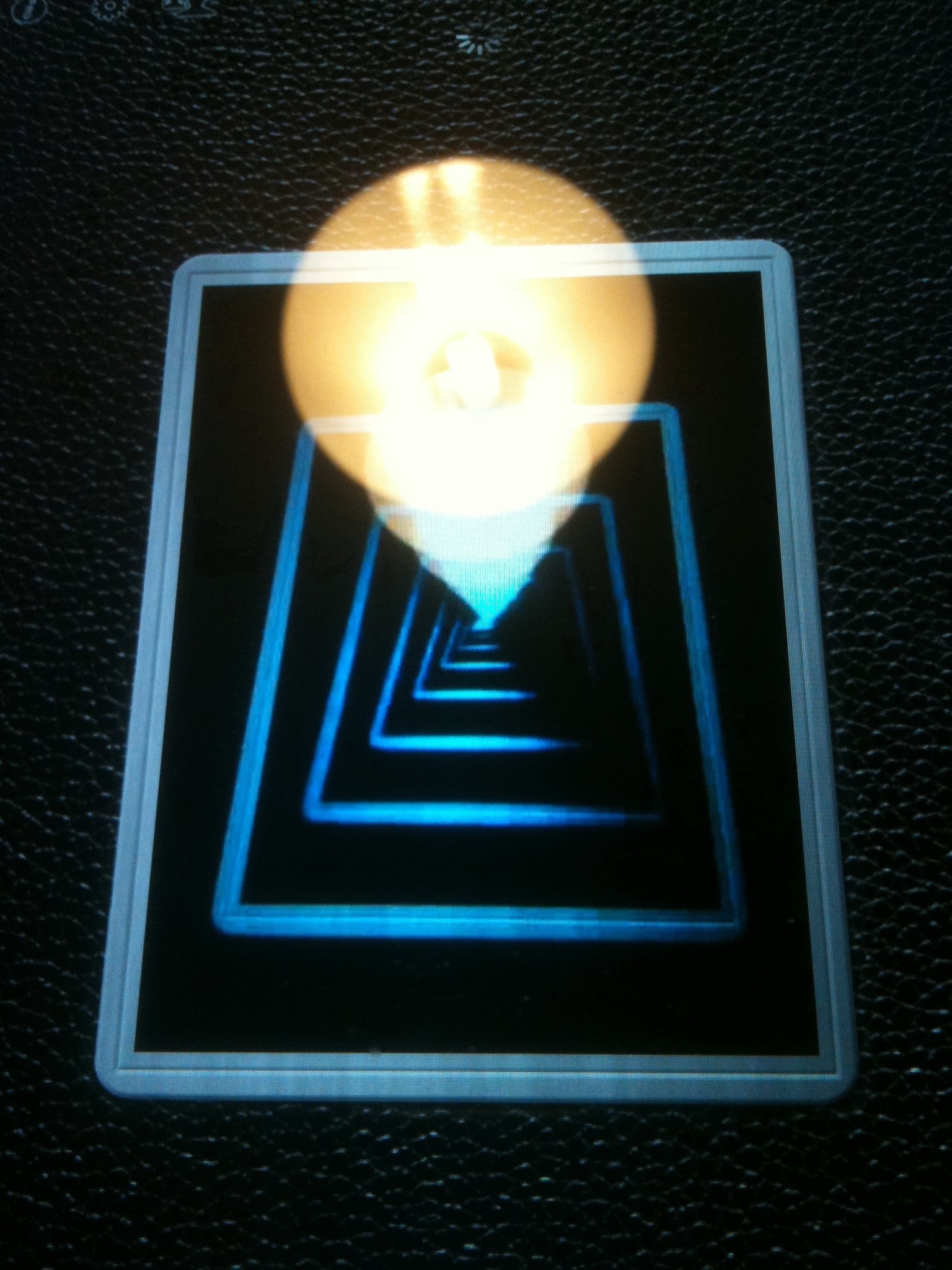
Pretty abstract for me, eh?

There’s an app called ‘Camera for iPad’ which allows your iPhone to be used as a remote camera for an iPad, which doesn’t have a camera of its own. Quite fun. It shows a ‘viewfinder’ on the iPad, so of course I pointed the camera at that.

So this is a view, taken on an iPhone, of a view on an iPad of what an iPhone is seeing when the iPhone camera is pointed at the iPad. The kitchen ceiling light is reflected in the iPad screen.

Joke of the day

A bit belated. This one came originally from (or via) Stephen Fry in December:

Darth Vader: I know what you are getting for Christmas, Luke Skywalker Luke Skywalker: You can't possibly know. Vader: I know what you are getting for Christmas, Luke. Luke: You cannot know. How can you know? Vader: For I have felt your presents...

That syncing feeling...

Just setting up a new laptop here, readers, and enabling Address Book's built-in sync with Google Contacts so as to bring all my contacts over and... aargh! What is this I see? For some reason, the syncing system has decided that the new, empty address book with zero contacts is the up-to-date version, and so has deleted all my contacts from my Google account to make it match! Woe is me!

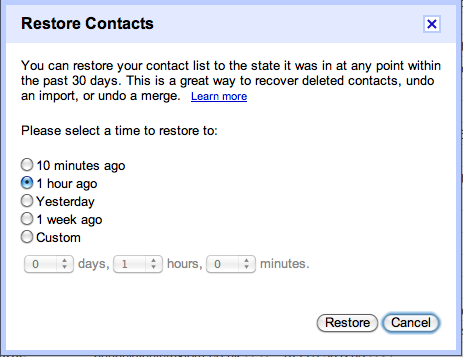
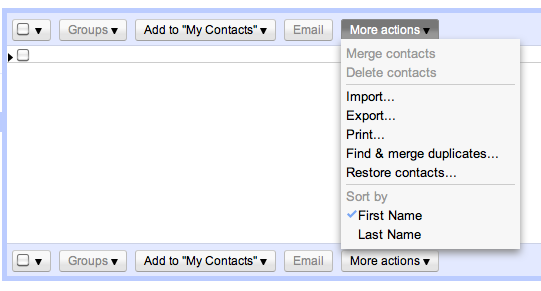
Now, I was about to write this up as a cautionary tale of cloud computing: if I didn't have my own local copy of my data here, I might have been in quite a pickle. But then I discovered that the good folks at Google hadn't allowed data just to vapourise... there's a handy option in the More Actions menu of Google Contacts, which lets you restore your lost contacts.

Phew!

Circuitry for the brain

Are you socially handicapped by your lack of electronics knowledge? Wishing you could remember more from school physics/IT lessons? Ever wondered what these strange transistor things are and why they were so important?

I've just come across a very nice site called JeeLabs by Jean-Claude Wippler - thanks, Aideen - and in particular a set of posts called Easy Electrons, which introduce resistors, capacitors, diodes, transistors, and some of the things you can do with them.

It's not a series for complete beginners - you need to have some grasp of voltage and current and the relationship between them - but if you've ever wondered "Do I need a resistor with this LED, and if so, why, and how big should it be?", or "Why is my transistor getting hot?", then this could be useful reading.

I liked the ones about diodes and the set of posts about transistors....

Capturing the coolness

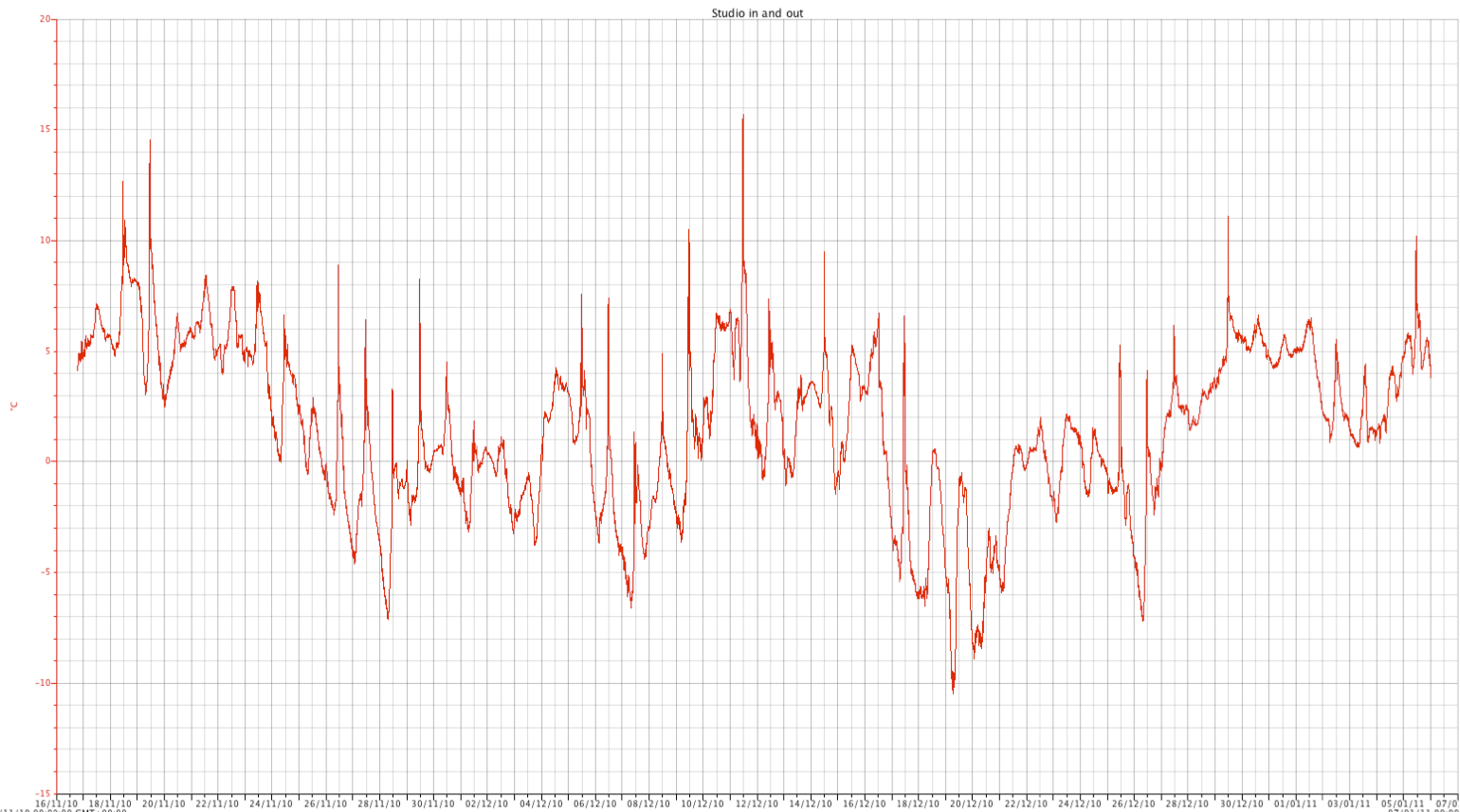
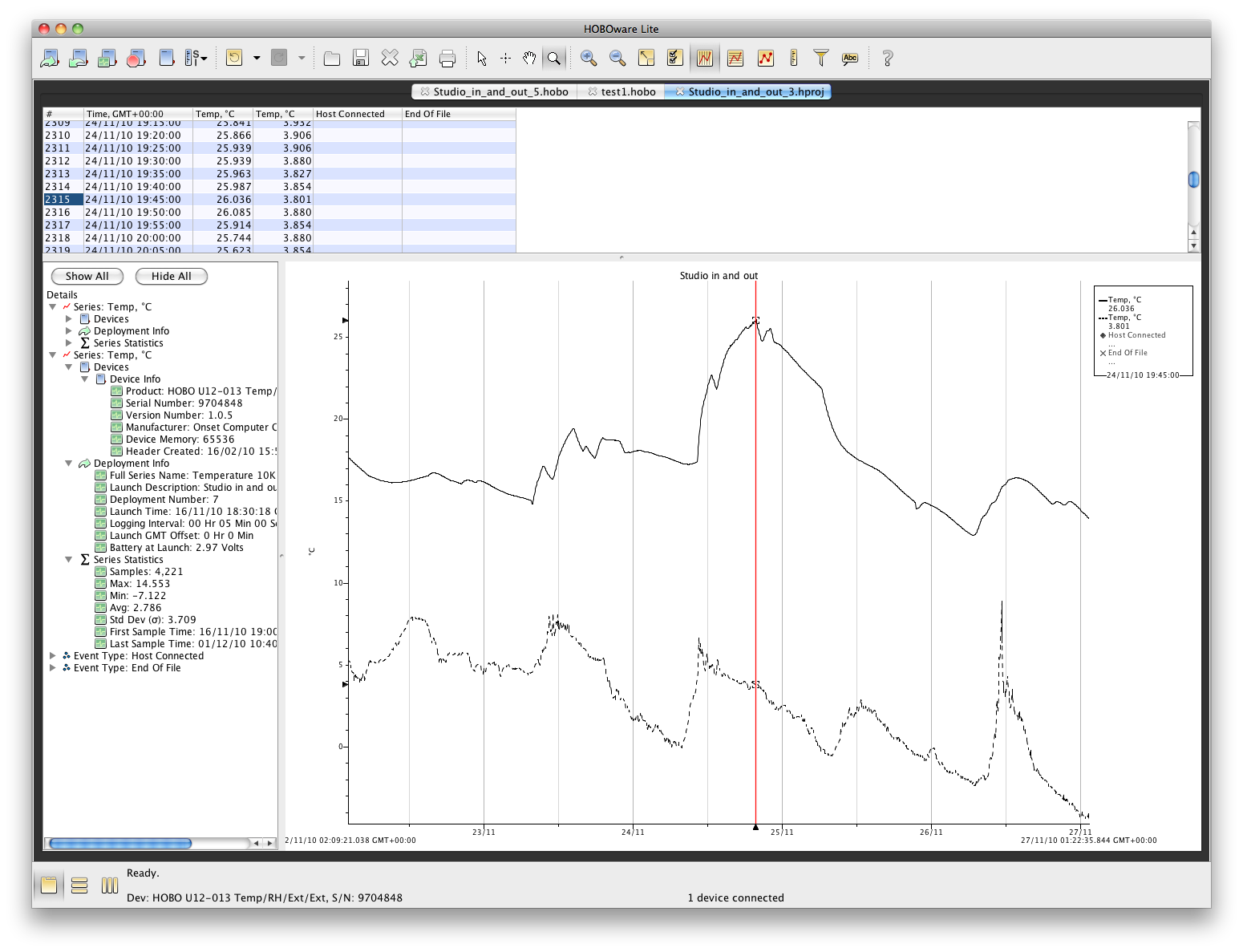
The coldest moment in my part of Cambridge recently was at 6.50 on the morning of Dec 19th, when the temperature in my back garden reached -10.5 deg C. Phawww!... Pretty chilly for here...

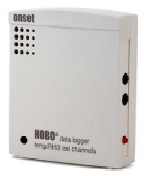
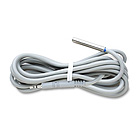
I know this interesting fact because one of last year's toys was a Hobo Datalogger and an external temperature probe, which I bought because I suspected the thermostat on my hot water boiler of misbehaving. It wasn't - but there are all sorts of situations where it's quite fun to be able to record temperatures over an extended period.

The Hobo's a lovely device, not much bigger than a matchbox, and you can configure it to capture data over a specified time period and at a particular frequency, and it'll run almost for ever on a very small battery.


Click for a bigger version. I hesitated for a while because I didn't feel like paying for the HOBOware software, which, even in its 'lite' variety, costs 40 quid. It seemed like a lot when all I wanted was a list of numbers: why couldn't they just let me get at the raw data? But I have to admit it does its job rather well, and it lets you configure the unit and navigate around any graphs produced. Also, I realised, the output of some of the sensor devices is not linear, so it's doing rather more than simply recording voltages.

The unit I bought has built-in humidity and temperature detectors, and sockets where you can plug in a couple of other sensors - my external probe let me record the temperature both inside the studio and outside. I'm now trying to resist buying accessories like current clamps, which would let me record the power going to the under-floor heating system...

All in all, a fun toy.